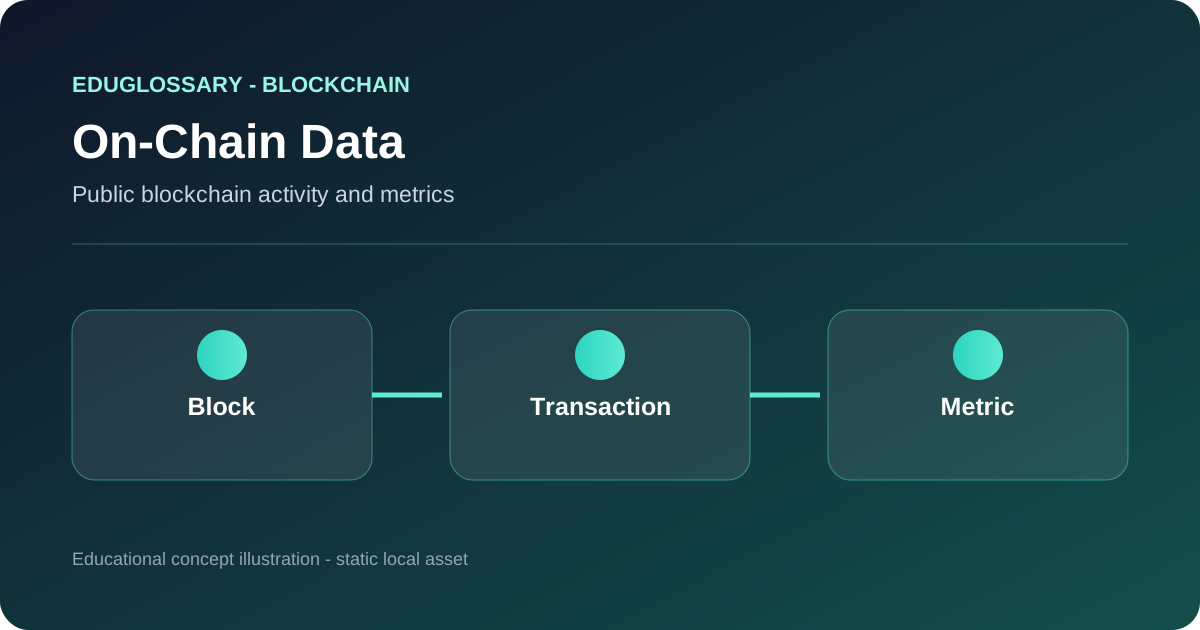
On-chain data is information recorded on a blockchain or derived directly from its public ledger. It can include blocks, transactions, wallet balances, token transfers, smart-contract calls, emitted events, validator activity, fees, and the relationships between addresses. Analysts use this data to study how a network operates and how assets move, but the raw record still requires careful interpretation.
What Is Recorded?
A block normally contains a set of transactions and metadata such as a timestamp, a reference to the previous block, and a cryptographic commitment to the included records. A transaction can transfer a native cryptocurrency, call a smart-contract function, deploy code, or update application state. Token balances may be represented indirectly through contract storage and transfer events rather than as a simple balance field in the block.
Indexing services collect these records and make them searchable. They may decode contract events, label addresses, group related transactions, calculate balances, and provide dashboards. The original ledger is the source of the raw record, while an indexer’s labels and derived metrics are an additional analytical layer.
Addresses Are Not Automatically People
Most public blockchain addresses are pseudonymous. A record can show that an address sent assets to another address, but it usually does not state the person’s name, location, employer, or purpose. Analysts can sometimes link an address to an exchange, protocol, company, or public owner through disclosures and behavioral patterns. Those links are hypotheses or classifications that should be distinguished from the transaction itself.
The same person can control many addresses, and one service can control addresses for many customers. A contract can also move assets on behalf of users. These factors make address counts a weak substitute for user counts unless the methodology explains how entities are grouped.
Common On-Chain Metrics
Researchers may track transaction count, transfer value, active addresses, new addresses, gas use, fees, token-holder balances, contract calls, bridge flows, or validator participation. In Decentralized Finance (DeFi), dashboards can derive Total Value Locked (TVL), liquidity, loans, swaps, and protocol revenue from balances and events.
These metrics answer different questions. Transaction count measures recorded operations, not necessarily economic value. Transfer volume can include internal movements, exchange rebalancing, or smart-contract routing. Active addresses count addresses under a chosen definition, not verified people. TVL can change when token prices move, even without new deposits. Good analysis states the time window, chain coverage, token treatment, entity labels, and exclusions.
On-Chain and Off-Chain Activity
Blockchain records do not contain every part of a crypto market. A centralized exchange may match trades in its internal ledger and publish only deposits and withdrawals on-chain. Orders, account balances, derivatives positions, and many business arrangements can remain off-chain. An analyst who looks only at public transfers may miss that activity or misread an exchange’s internal movement as user demand.
Data can also cross chains through bridges, wrapped assets, or messaging systems. Counting both a source asset and its representation on a destination chain can overstate the amount of unique economic value. Stablecoin supply, contract balances, and token burns require similar care when units are issued, redeemed, or moved between networks.
Uses and Limits
On-chain data supports protocol monitoring, operational alerts, compliance analysis, academic research, public auditing, and historical study. It can reveal contract usage and settlement paths more directly than a private database. A Blockchain can make the underlying record tamper-evident, but data quality still depends on the protocol, indexer, price source, and analytical assumptions.
Privacy is another consideration. Public visibility can make payments traceable even when addresses do not display legal names. Mixing services, privacy tools, encrypted metadata, and off-chain accounts can reduce observability, while mistakes in address reuse can expose relationships. Public data should not be treated as permission to infer sensitive facts about individuals.
Raw Records Versus Derived Metrics
A blockchain ledger provides raw records, but most dashboards show derived information. A transaction hash, block number, contract address, and event log are close to the underlying record. A metric such as “active users,” “protocol revenue,” or “economic volume” requires additional rules.
The distinction matters because two analysts can start from the same blocks and produce different totals by choosing different entity labels, time windows, token mappings, or exclusions. A derived metric should therefore be treated as an analytical model built on ledger data, not as a primitive fact directly written into the chain.
Entity Labels and Address Clustering
Analysts often label addresses as exchanges, bridges, protocols, treasuries, validators, or other categories. Labels may come from public disclosures, known contract deployments, clustering methods, or provider-maintained databases. They can be extremely useful, but they can also become outdated when services change addresses or contracts.
Address clustering creates a similar challenge. One person or organization can control multiple addresses, while one exchange can control addresses belonging to many customers. A count of active addresses should not be presented as a verified count of individual users unless the methodology supports that interpretation.
Measuring Economic Activity
Transaction counts, transfer volume, fees, active addresses, smart-contract calls, and token balances each measure different aspects of network activity. Automated contracts can generate large numbers of transactions without corresponding human activity. Token transfers can also represent internal routing, collateral movements, exchange rebalancing, or accounting operations.
For this reason, “volume” is especially sensitive to methodology. A useful data product explains whether it removes known internal transfers, applies entity labels, deduplicates bridge movements, or excludes technical transactions. Without these rules, a large number can be mistaken for large economic activity.
Reorganizations, Indexing, and Data Quality
Some blockchain systems can experience reorganizations or temporary disagreements before consensus settles on the canonical chain. Indexers must process these events correctly or risk presenting records that later change. Data pipelines can also fail through delayed ingestion, incorrect token decimals, contract upgrades, broken address labels, or stale prices.
Reliable analysis uses timestamps, block references, provider documentation, and independent cross-checks. Critical figures should be reproducible from a defined query or source version where practical.
Privacy and Ethical Use
Public availability does not mean that every inference about an address is reliable or appropriate. Blockchain analysis can sometimes connect pseudonymous addresses to real-world entities, but uncertainty can remain. Mistaken attribution can harm individuals or organizations.
A responsible workflow separates observed facts from inferred identities, reports uncertainty, and avoids exposing unnecessary personal information. On-chain data is powerful precisely because it can reveal relationships that users may not expect to be obvious.
Building a Sound On-Chain Dataset
A robust dataset should record the chain, block range, timestamp convention, contract addresses, token identifiers, price source, entity labels, and exclusions. It should distinguish native assets from wrapped or bridged representations and document how duplicate economic positions are handled.
This metadata is as important as the raw numbers. Without it, a chart may be visually convincing while remaining impossible to reproduce or compare. For educational and research content, stating the methodology is part of the data itself.
A Practical Example
Consider a decentralized exchange transaction. The raw ledger may show the wallet address, block, transaction hash, contract call, token-transfer events, and network fee. An analytics provider can turn those records into labels such as trader, protocol, volume, and price impact.
Each step adds interpretation. The raw event may be directly verifiable, while the statement that it represents one human user’s trade may depend on address labeling and entity clustering. Good reports therefore separate the observable transaction from the conclusions drawn from it.
Data Freshness Matters
On-chain data can be collected close to block time, but derived dashboards may update on their own schedules. Prices can lag, token metadata can change, and entity labels can be corrected after publication. A “current” value should therefore include a retrieval timestamp when precision matters.
Historical data also needs a defined cutoff. A dashboard that recalculates past values using updated labels or prices may show a different historical figure than an earlier report. Reproducible analysis should preserve the query date, data source, and relevant methodology.
Multi-Chain Comparisons
Comparing chains requires consistent units and definitions. Block times, transaction models, fee markets, address formats, token standards, and smart-contract architectures differ. A simple transaction-per-second comparison can be misleading if one system counts different kinds of operations.
Likewise, cross-chain asset movements can create apparent activity on several networks without representing several independent economic transactions. Analysts should document bridges, wrapped assets, and duplicated representations before aggregating data across chains.
Is on-chain data always accurate?
The ledger records what the protocol accepted, but derived labels and metrics can be wrong or incomplete. Smart-contract bugs, reorganizations, indexer errors, price assumptions, and entity-classification mistakes all require review.
Does on-chain data show all crypto activity?
No. It excludes or only partially represents many centralized-exchange, custodial, private, and off-chain activities.
Can on-chain data predict prices?
It can describe historical activity and observable conditions, but it cannot guarantee future prices or outcomes. Interpretation remains uncertain and market conditions can change quickly.
From raw records to defensible metrics
Raw blockchain data consists of blocks, transactions, logs, and state changes, but most business questions require derived metrics. A metric may depend on the way addresses are grouped, the assets included, the pricing source, the treatment of internal transfers, and the block timestamp used. Document each transformation so another analyst can reproduce the result. Keep raw data separate from labels and estimates to make corrections traceable.
Address clustering can be useful, but it is an inference, not a direct identity record. Heuristics that connect addresses may produce false positives, and a wallet may be used by multiple people or services. Avoid describing an address as a named individual without reliable evidence and a legitimate reason. Published labels should include provenance, confidence, and update date where practical.
Handling reorganizations and stale sources
Some chains can replace recent blocks before a transaction reaches the required finality. An indexer may initially expose a transaction and later revise the record after a reorganization. Data pipelines should define confirmation policies, support corrections, and make freshness visible. Compare the block height and timestamp with the data provider’s ingestion time; a recent-looking dashboard can still be based on delayed indexing.
Cross-chain comparisons need particular care. Native assets, wrapped tokens, bridged assets, and protocol representations can refer to the same underlying economic value. Counting every representation as independent activity can double-count value. Token decimals, symbol collisions, chain identifiers, and contract addresses must be treated explicitly rather than relying only on token names.
Responsible analysis
On-chain transparency does not make every inference reliable or ethical. Public addresses can sometimes be linked to people through exchange records, public statements, or behavioral patterns. Limit access to sensitive investigative datasets, document uncertainty, and avoid exposing individuals through speculative labeling. Use external prices and off-chain information with timestamps and stated methodology. On-chain data is powerful for auditing network activity and forming hypotheses, but price forecasts and claims about human intent require evidence beyond transaction counts alone.