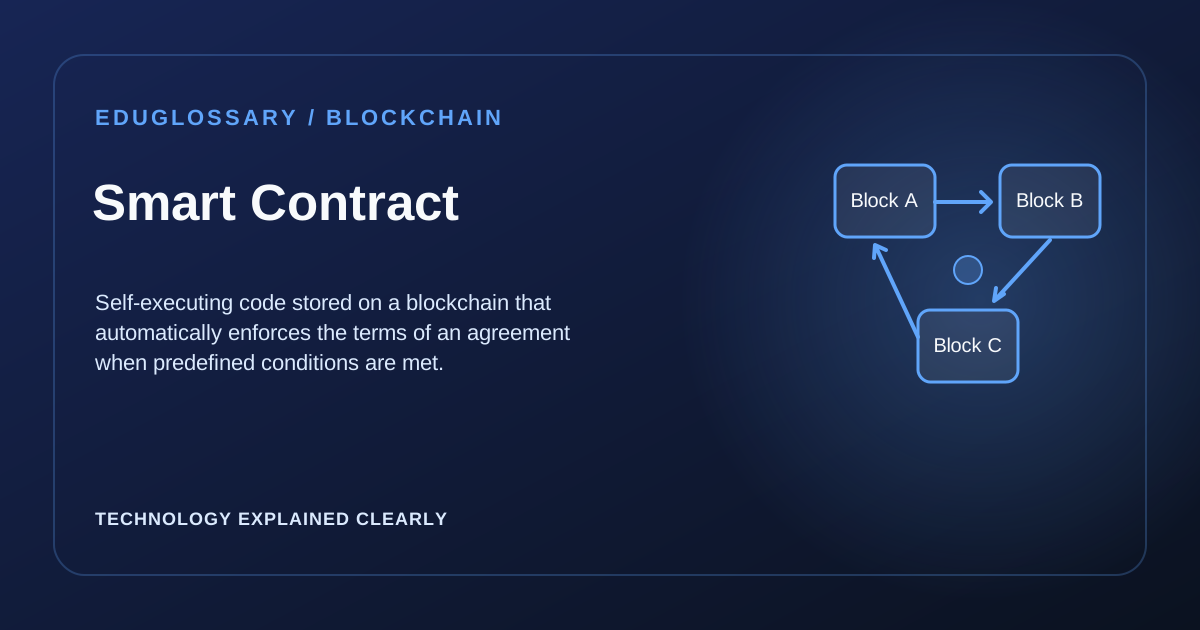
A smart contract is a program stored on a blockchain that executes automatically when predefined conditions are satisfied. Unlike traditional contracts that rely on legal enforcement and human intermediaries, smart contracts enforce their terms through code — the blockchain network itself guarantees execution.
The term was coined by computer scientist Nick Szabo in 1997, long before practical blockchain platforms existed. Szabo’s analogy was a vending machine: you insert the correct amount (condition), and the machine dispenses your drink (execution) without requiring a human clerk. Smart contracts apply this principle to complex digital agreements.
How Smart Contracts Work
Smart contracts run on blockchain platforms that support general-purpose computation, most notably Ethereum. A developer writes the contract logic in a language like Solidity or Vyper, deploys it to the blockchain, and it receives a fixed address. Anyone can interact with the contract by sending transactions to that address.
The execution process follows these steps:
- Deployment: The contract code is submitted to the blockchain with an initial transaction
- Address assignment: The contract receives a unique address on the blockchain
- Interaction: Users call contract functions by sending transactions
- Execution: Network validators execute the contract code deterministically
- State update: Contract state changes are recorded on-chain
- Event emission: Contracts emit events to signal outcomes
Once deployed, the code is immutable — it cannot be changed. This immutability is both a strength (no one can tamper with the contract terms) and a limitation (bugs cannot be patched after deployment without deploying a new contract at a new address).
What Makes Smart Contracts Trustworthy
Deterministic execution: Given the same inputs, a smart contract always produces the same output. There is no ambiguity or discretion. This property is essential for a decentralized network where all nodes must agree on outcomes.
Transparent terms: The code is publicly visible on the blockchain. Anyone can audit the contract logic before interacting with it. This transparency builds trust through verifiability.
Tamper-proof: Once deployed, the contract code cannot be altered by any single party. The blockchain’s consensus mechanism ensures all nodes execute the same code identically.
Atomic execution: Smart contracts either execute completely or not at all. Partial execution is not possible — this prevents states where one party fulfills their obligation but the other does not.
Automatic enforcement: No intermediary is needed to ensure compliance. The code itself enforces the terms, eliminating counterparty risk.
Programming Languages and Platforms
Solidity: The most popular language for Ethereum smart contracts. Syntax resembles JavaScript and C++. Compiled to EVM (Ethereum Virtual Machine) bytecode.
Vyper: A Python-like language for Ethereum, designed for security and simplicity. Fewer features than Solidity but harder to write vulnerable code.
Rust: Used for Solana, Near, and Polkadot contracts. Offers memory safety and performance benefits.
Move: Designed for safety-critical contracts, used by Aptos and Sui. Prevents common vulnerabilities through resource-oriented programming.
Scilla: Used by Tezos, separates communication and state transitions for formal verification.
Practical Applications
Decentralized Finance (DeFi)
DeFi is the largest smart contract application category:
- Lending protocols (Aave, Compound): Pool deposits, calculate interest rates, manage collateral liquidation automatically
- Decentralized exchanges (Uniswap, SushiSwap): Facilitate token swaps without centralized order books using automated market makers (AMMs)
- Yield farming: Users provide liquidity to earn rewards through algorithmic distribution
- Derivatives: Synthetics, options, and futures traded without intermediaries
Non-Fungible Tokens (NFTs)
NFTs are smart contracts that track ownership and transfer rights for unique digital assets:
- ERC-721: The original NFT standard on Ethereum
- ERC-1155: Multi-token standard supporting both fungible and non-fungible tokens
- Metadata: Links to off-chain data (images, videos, descriptions)
- Marketplaces: OpenSea, Rarible enable NFT trading through smart contracts
Decentralized Autonomous Organizations (DAOs)
DAOs use smart contracts to manage organizational governance:
- Token-based voting: Members vote proportional to token holdings
- Treasury management: Funds are controlled by multi-signature contracts
- Proposal execution: Approved proposals execute automatically
- Transparent operations: All decisions and transactions are public
Supply Chain Management
Smart contracts automate payments when shipment tracking data confirms delivery milestones:
- Condition-based payments: Release funds when goods reach specific locations
- Provenance tracking: Record each step of product journey
- Automated compliance: Verify certifications and standards
- Dispute resolution: Immutable records reduce conflicts
Insurance
Parametric insurance uses smart contracts for automatic payouts:
- Flight delay insurance: Pays automatically when flight is delayed
- Crop insurance: Triggers based on weather station data
- Event cancellation: Refunds when events are cancelled
- Critical illness: Payouts based on medical diagnosis verification
Limitations and Risks
Bugs are permanent: A vulnerability in deployed code cannot be patched. The 2016 DAO hack exploited a reentrancy bug in a smart contract, resulting in the theft of 3.6 million ETH. The Ethereum community ultimately performed a hard fork to reverse the damage, but this required extraordinary coordination.
Oracle dependency: Smart contracts cannot access external data (price feeds, weather, sports results) on their own. They rely on oracle services (like Chainlink) to feed external data on-chain, introducing a trust assumption at the oracle layer. If an oracle is compromised, all dependent contracts are affected.
Gas costs: Every computation on Ethereum costs gas, paid by the transaction sender. Complex contract logic can become expensive to execute, creating economic barriers for users. Gas prices fluctuate based on network congestion.
Legal uncertainty: In most jurisdictions, the legal status of smart contracts remains unsettled. Code-based enforcement and legal enforcement operate in different frameworks, and courts have limited precedent for adjudicating smart contract disputes.
Immutability problems: If business requirements change, contracts cannot be updated. Upgrade patterns (proxy contracts, migration strategies) add complexity and potential vulnerabilities.
Front-running: Transactions are visible before execution, allowing bots to reorder or exploit transactions. Techniques like commit-reveal schemes and private transaction pools mitigate this.
Security Best Practices
Formal verification: Mathematically proving contract correctness before deployment.
Audit requirements: Professional security audits by firms like CertiK, Trail of Bits, or OpenZeppelin.
Bug bounty programs: Incentivizing white-hat hackers to find vulnerabilities.
Multisig wallets: Requiring multiple signatures for contract upgrades.
Upgrade patterns: Using proxy contracts to enable logic updates while preserving state.
Access control: Implementing role-based permissions and pausable contracts.
Reentrancy guards: Preventing recursive function calls that drain contracts.
Integer overflow protection: Using libraries like SafeMath or Solidity 0.8+ built-in checks.
Future Developments
Layer 2 solutions: Optimistic rollups and ZK-rollups reduce gas costs while maintaining security.
Cross-chain interoperability: Protocols like Polkadot and Cosmos enable contracts to interact across chains.
Zero-knowledge proofs: Enable private computations on public blockchains.
Quantum resistance: Developing contracts resistant to quantum computing attacks.
Regulatory compliance: Building KYC/AML features directly into contracts.
AI integration: Combining smart contracts with machine learning models for complex decision-making.
Real-World Examples
Uniswap: Automated token exchange using constant product formula (x * y = k). Over $100 billion in cumulative trading volume.
Aave: Permissionless lending protocol with flash loan capabilities. Enables collateral-free borrowing for arbitrage.
MakerDAO: Decentralized stablecoin (DAI) overcollateralized by crypto assets. Operates as a decentralized central bank.
Compound: Algorithmic money market where interest rates are determined by supply and demand.
Axie Infinity: Blockchain game where players earn tokens by battling and breeding digital creatures.
Frequently Asked Questions
Are smart contracts legally binding?
Not necessarily. Most smart contracts are code-only agreements. Some jurisdictions recognize them as legally enforceable, but this is evolving. Legal wrappers can combine code execution with legal enforcement.
Can smart contracts be hacked?
Yes. Vulnerabilities like reentrancy, integer overflow, and oracle manipulation have led to billions in losses. Thorough auditing and security practices are essential.
Do smart contracts replace lawyers?
No. They automate routine transactions but complex agreements still require legal expertise for interpretation, dispute resolution, and regulatory compliance.
What is gas in smart contracts?
Gas is the fee paid for executing contract operations. It compensates validators for computational resources and prevents spam by making transactions costly.
Can smart contracts access the internet?
Not directly. They need oracles to fetch external data. This maintains blockchain determinism but introduces trust assumptions.
Treat deployment as a security-critical release
A smart contract can preserve programmed rules while still implementing the wrong rules. Before deployment, write down the intended invariants—for example, who may transfer an asset, how balances must reconcile, whether withdrawals can be paused, and what must remain true after an upgrade. Use unit tests, integration tests, property-based tests, static analysis, and adversarial review to examine both expected paths and unusual sequences of calls. A successful test suite is evidence, not a guarantee that every possible execution has been considered.
Review access-control functions, administrator privileges, upgrade keys, external calls, arithmetic assumptions, and any dependency on an oracle or bridge. Reentrancy and incorrect authorization are examples of classes of bugs that can produce serious consequences. Prefer well-reviewed libraries and standard patterns over custom implementations when possible. A pause mechanism may help contain an incident, but it creates an authority that must be governed and protected; document who can invoke it and under what conditions.
Oracles and off-chain reality
A contract cannot directly know an external fact such as a shipment arriving, a stock price, or a weather reading. It relies on a trusted reporter or oracle mechanism. If the input is wrong, a contract can execute exactly as designed and still produce a harmful result. Evaluate the oracle’s data sources, update frequency, manipulation resistance, and failure behavior.
Upgrade and incident planning
Immutable code reduces some kinds of unauthorized change but makes a bug difficult to repair. Upgradeable contracts allow controlled changes but introduce governance and key-compromise risk. Document the upgrade authority, review and delay process, storage-layout constraints, user notification, and emergency response. Monitor contract events and unusual flows after launch, and keep a communication plan for users.
A smart contract is one component of an application that can also include wallets, interfaces, servers, bridges, and legal agreements. Security review must cover these dependencies together. Code can automate enforceable rules, but it cannot automatically settle every legal, organizational, or real-world dispute.