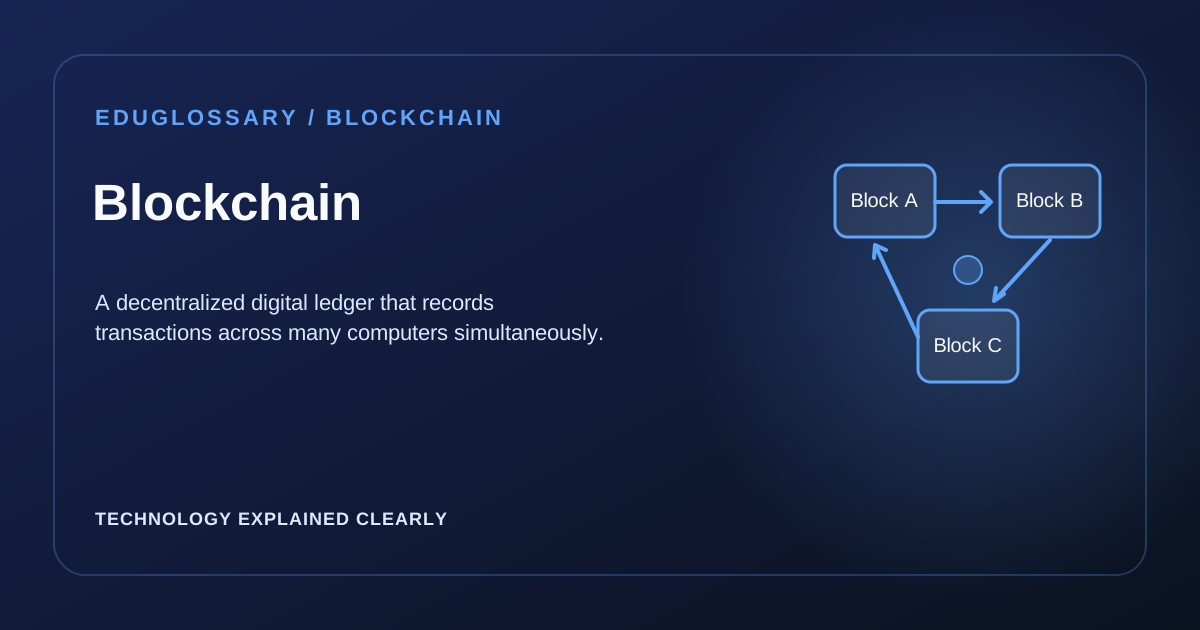
Blockchain is a data structure that stores transaction records in the form of “blocks” that are linked together chronologically and cryptographically secured. Each block contains the hash (a fixed-length digital fingerprint) of the previous block, creating a chain where altering any historical record would require recomputing every subsequent block — a task that is computationally infeasible on a sufficiently large network.
This property — immutability — is what makes blockchain valuable: once data is recorded and confirmed by the network, it cannot be changed or deleted without detection. Any attempt to modify a block changes its hash, which breaks the chain and is immediately rejected by other nodes.
How Blockchain Works
The fundamental process involves several steps:
- Transaction creation: A user initiates a transaction (sending cryptocurrency, executing a smart contract, recording data)
- Broadcasting: The transaction is broadcast to the network of nodes
- Validation: Nodes validate the transaction according to consensus rules
- Block formation: Validated transactions are grouped into a candidate block
- Consensus: Nodes agree on the block’s validity through a consensus mechanism
- Chain addition: The new block is added to the blockchain
- Distribution: The updated chain is propagated to all nodes
Every node maintains its own copy of the complete blockchain. This distributed nature ensures no single point of failure and makes the system resilient to attacks.
Blockchain Anatomy
Each block contains:
- Header: Metadata including version, timestamp, previous block hash, Merkle root, nonce, and difficulty target
- Transaction list: The actual data being recorded
The previous block hash creates the cryptographic link between blocks. Changing any data in a historical block would change its hash, which would invalidate all subsequent blocks — requiring recalculation of all proof-of-work or re-staking of all validators.
Types of Blockchains
Public Blockchains
Open to anyone to join, read, write, and validate:
- Bitcoin: First blockchain, focused on digital currency
- Ethereum: Smart contract platform enabling DeFi and dApps
- Solana: High-throughput blockchain for applications
- Cardano: Research-driven approach to blockchain
Public blockchains prioritize decentralization and censorship resistance over speed and privacy.
Private Blockchains
Restricted access, controlled by a single organization:
- Hyperledger Fabric: Enterprise-grade permissioned blockchain
- R3 Corda: Designed for financial institutions
- Corda Enterprise: Private version of Corda
Private blockchains prioritize efficiency and privacy over decentralization.
Consortium Blockchains
Controlled by a group of organizations rather than a single entity:
- Used by banking consortia for interbank settlements
- Supply chain networks with multiple stakeholders
- Industry-specific collaboration platforms
Hybrid Blockchains
Combine public and private elements:
- Public verification with private transactions
- Selective data disclosure
- Flexible privacy controls
Key Properties
Decentralization: No single entity controls the network. Power is distributed among participants.
Immutability: Once recorded, data cannot be altered without detection. Creates trustless verification.
Transparency: All transactions are visible to network participants (amount varies by blockchain type).
Security: Cryptographic techniques protect data integrity and participant identities.
Auditability: Complete transaction history is available for verification.
Fault tolerance: Network continues operating even if some nodes fail.
Consensus Mechanisms
Blockchains use consensus mechanisms to agree on the valid state:
Proof of Work (PoW): Miners compete to solve computational puzzles. Used by Bitcoin. Energy-intensive but battle-tested.
Proof of Stake (PoS): Validators stake cryptocurrency to participate. Used by Ethereum. More energy-efficient.
Delegated Proof of Stake (DPoS): Token holders vote for delegates. Faster but more centralized.
Practical Byzantine Fault Tolerance (PBFT): Multi-round voting consensus. Used in permissioned blockchains.
The choice of consensus mechanism affects security, speed, decentralization, and energy consumption.
Smart Contracts and dApps
Smart contracts are programs stored on blockchain that execute automatically when conditions are met. They enable complex applications beyond simple transactions.
Decentralized applications (dApps) run on blockchain infrastructure:
- DeFi: Decentralized finance protocols
- NFTs: Digital collectibles and assets
- DAOs: Decentralized autonomous organizations
- Games: Blockchain-based gaming platforms
- Identity: Self-sovereign identity systems
Smart contracts have been estimated to have lost over $3 billion to exploits since 2018, highlighting the importance of security audits.
Real-World Applications
Finance
- Cross-border payments (faster, cheaper than traditional banking)
- Remittances (lower fees)
- Decentralized lending and borrowing
- Tokenization of real-world assets
Supply Chain
- Product provenance tracking
- Anti-counterfeiting
- Automated payments on delivery
- Compliance verification
Healthcare
- Medical records management
- Drug traceability
- Clinical trial data integrity
- Patient consent management
Government
- Voting systems
- Land registry
- Identity verification
- Public procurement
Intellectual Property
- Copyright registration
- Royalty distribution
- Authenticity verification
- Licensing management
Scalability Challenges
Blockchains face the scalability trilemma — it’s difficult to achieve decentralization, security, and scalability simultaneously:
Layer 1 solutions: Protocol-level improvements
- Sharding (dividing the network into parallel chains)
- Larger block sizes
- Faster block times
- Improved consensus algorithms
Layer 2 solutions: Built on top of existing blockchains
- Lightning Network (Bitcoin payment channels)
- Rollups (Ethereum scaling solutions)
- Sidechains (parallel blockchains)
- State channels
Layer 3 solutions: Application-specific optimizations
Security Considerations
51% attacks: Controlling majority of network hash rate or stake to rewrite history. Economically prohibitive for large networks.
Smart contract bugs: Vulnerabilities in contract code can lead to fund loss. Audits and formal verification reduce risk.
Private key management: Losing private keys means losing access to assets. Hardware wallets and multi-signature solutions help.
Bridge vulnerabilities: Cross-chain bridges have been exploited for billions. They remain a significant risk.
Exchange hacks: Centralized exchanges are attractive targets. Not blockchain vulnerabilities per se, but affect user confidence.
Regulatory Landscape
Regulation varies globally:
- United States: SEC, CFTC oversight; evolving guidance
- European Union: MiCA regulation providing comprehensive framework
- Asia: Mixed approaches from ban (China) to embrace (Singapore, Japan)
- Developing nations: Some adopting blockchain for financial inclusion
Regulatory clarity is improving but remains a challenge for enterprise adoption.
Future Trends
Interoperability: Cross-chain communication protocols (Polkadot, Cosmos) Central Bank Digital Currencies (CBDCs): Government-issued digital currencies Green blockchain: Proof of Stake adoption reducing energy concerns Institutional adoption: Traditional finance integrating blockchain Quantum resistance: Preparing for quantum computing threats Identity solutions: Self-sovereign identity on blockchain
Frequently Asked Questions
What is the difference between a blockchain and a database?
A database is typically centralized — controlled by one organization that can modify, delete, or override records. A blockchain is decentralized and append-only: once data is written and confirmed by the network, it cannot be altered without detection. Databases prioritize speed and control; blockchains prioritize trustlessness and auditability.
How does Proof of Work differ from Proof of Stake?
Proof of Work (PoW) requires miners to solve computational puzzles to propose blocks — energy-intensive but battle-tested (Bitcoin). Proof of Stake (PoS) selects validators based on the amount of cryptocurrency they stake as collateral — far more energy-efficient (Ethereum post-Merge). Both achieve consensus but with different security models and resource requirements.
Can a blockchain be hacked?
The blockchain protocol itself (consensus, cryptography) is extremely hard to attack — a 51% attack on a major network would cost billions. However, vulnerabilities often exist at the application layer: smart contract bugs, bridge exploits, private key theft, or exchange hacks. “Blockchain hacks” are almost always smart contract or infrastructure failures, not protocol breaks.
What is a smart contract?
A smart contract is self-executing code stored on a blockchain that automatically enforces the terms of an agreement when predefined conditions are met. It runs exactly as programmed, without intermediaries. Common uses: token transfers, decentralized exchanges, lending protocols, and NFTs.
Why do public blockchains need tokens/coins?
Tokens provide economic incentives for network security. In PoW, miners earn block rewards and fees. In PoS, validators stake tokens and earn rewards for honest behavior; dishonest behavior risks slashing (losing staked tokens). The token aligns economic incentives with protocol integrity — without it, there’s no reason for participants to secure the network.
Evaluating whether blockchain is necessary
A blockchain is useful when several parties need to share a state transition history and cannot or do not want to rely entirely on one operator. It is often a poor fit when one trusted organization controls all writers and can meet the audit requirement with a conventional database. Distributed consensus introduces latency, fees, key-management obligations, and governance complexity. Start by documenting the trust relationships, the parties who can write data, and the consequences of conflicting records.
A blockchain also stores only what the protocol and applications actually submit. Recording a hash can help later verification, but it does not make the underlying document true or prevent the original document from being deleted. If personal or confidential information is published to an immutable public network, it may be impossible to remove it later. Store sensitive data off-chain where appropriate and carefully consider whether a public commitment or pointer itself reveals information.
Application and infrastructure risks
The user experience depends on wallet software, signing keys, node providers, RPC endpoints, bridges, oracles, indexers, and smart contracts. A chain may remain available while a hosted interface fails or a bridge is exploited. Review each dependency and distinguish protocol-level security from the security of an application built on top of it. For valuable transactions, use tested contracts, explicit permission controls, event monitoring, and an incident plan.
Questions for a project review
Ask who can upgrade the software, pause a contract, freeze assets, change validator rules, or recover from a bug. Determine whether the network is permissioned, how participants are selected, what fees users pay, and how congestion affects confirmation time. Define the finality policy for the intended transaction size. For a supply-chain use case, also verify how real-world events are entered and audited; consensus can agree on a false input just as efficiently as a true one. Blockchain should be selected for a specific coordination and verification need, not merely because a record is digital or valuable.
Data governance beyond the ledger
Before writing a record to a public or shared chain, decide whether the data should be public indefinitely. Personal information, commercially sensitive records, and secrets should generally not be placed directly into an immutable public data structure. Hashes and pointers can still leak information when the underlying data is predictable or can be correlated with other records. A safer design defines what belongs on-chain, what remains in controlled storage, who can correct the off-chain record, and how users verify that the pointer has not changed.
For enterprise use, establish who is allowed to submit events and how those events are connected to real-world evidence. A ledger can preserve the sequence of submissions, but it cannot independently determine whether a warehouse scan, sensor reading, or human attestation is accurate. Require identity, validation, and audit controls at the point where the data enters the system. This separation helps teams avoid confusing tamper-evident recording with factual truth.