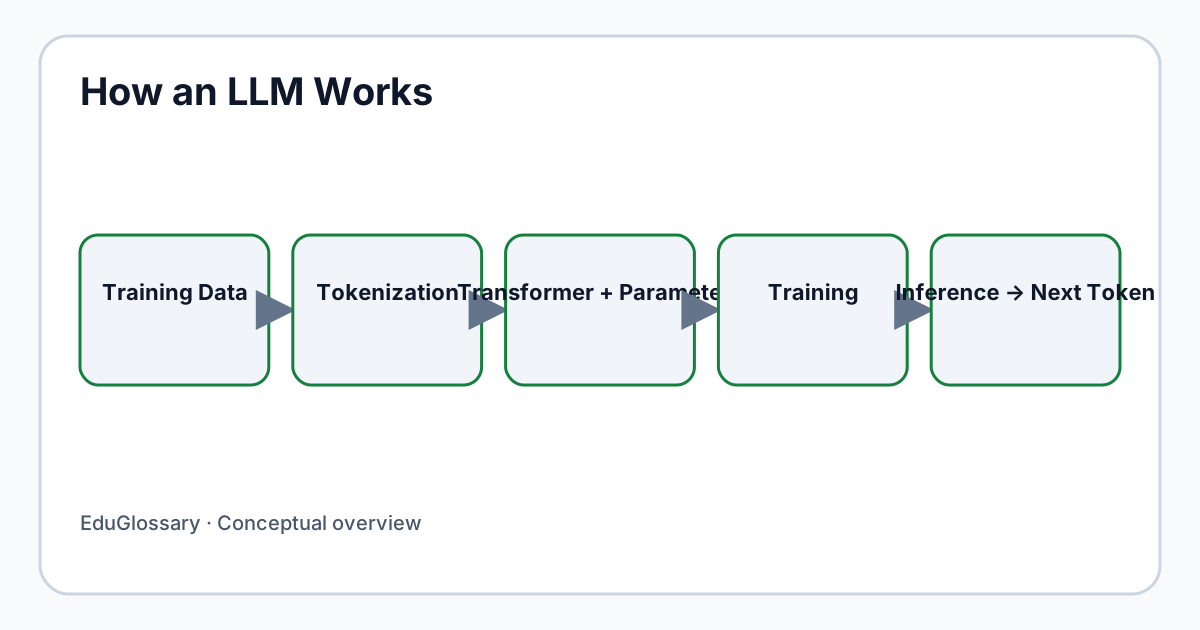
LLM stands for Large Language Model. It is the core technology behind ChatGPT, Claude, Gemini, and most modern AI assistants.
An LLM is a type of artificial intelligence trained on massive amounts of text to understand and generate human language. It doesn’t “know” facts the way a database does — it learns statistical patterns in language and uses them to predict what comes next.
This guide explains what LLMs are, how they work, and what they can (and cannot) do.
What Does LLM Stand For?
| Letter | Meaning |
|---|---|
| L | Large — Billions to trillions of parameters; trained on terabytes of text |
| L | Language — Designed for natural language (English, code, multilingual) |
| M | Model — A mathematical representation of learned patterns |
“Large” refers to both the model size (parameters) and the training data scale. Modern language models can contain very large numbers of learned parameters, but the exact parameter counts of many proprietary models are not publicly disclosed. The important beginner concept is that parameters are learned numerical values that help determine the model’s behavior.
What Is an LLM?
An LLM is a probabilistic text generator built on the Transformer architecture. Given a sequence of text (the prompt), it predicts the most likely next token (word piece), then the next, and so on — producing coherent, contextually relevant output.
It is not:
- A database of facts
- A reasoning engine with true understanding
- A deterministic program (same input ≠ same output)
It is:
- A statistical model of language
- Trained to minimize prediction error on next-token prediction
- Capable of remarkable generalization from pattern recognition
How Does an LLM Work?
At its core, an LLM performs next-token prediction:
Input: "The cat sat on the"Model: Predicts next token probabilities "mat" (45%), "floor" (20%), "rug" (15%), "chair" (10%), ...Output: "mat" (sampled or highest probability)Repeat this process, and you get sentences, paragraphs, articles, code.
The Transformer Architecture
LLMs use the Transformer architecture (introduced in “Attention Is All You Need”, 2017). Key innovations:
- Self-attention — Every token attends to every other token, capturing long-range dependencies
- Parallel processing — Unlike RNNs, all tokens processed simultaneously during training
- Layered depth — Dozens to hundreds of layers, each refining representations
- Residual connections — Enable training very deep networks
Input Tokens ↓Token Embeddings + Positional Embeddings ↓Transformer Layer 1 (Attention + Feed-Forward) ↓Transformer Layer 2 ↓... ↓Transformer Layer N ↓Output Logits (vocabulary probabilities) ↓Next TokenTraining vs Inference
These are two fundamentally different phases:
| Aspect | Training | Inference |
|---|---|---|
| Goal | Learn patterns from data | Generate output for a prompt |
| Data | Massive corpus (trillions of tokens) | User prompt + context |
| Compute | Weeks/months on GPU clusters | Milliseconds to seconds per request |
| Process | Forward + backward pass, gradient updates | Forward pass only |
| Parameters | Updated via backpropagation | Frozen (read-only) |
| Cost | Millions of dollars | Cents per million tokens |
| Determinism | Stochastic (randomness in sampling) | Deterministic if temperature=0 |
Training (Simplified)
- Data collection — Web pages, books, code, papers, Wikipedia (filtered, deduplicated)
- Tokenization — Text → integer token IDs
- Pre-training — Next-token prediction on massive corpus (self-supervised)
- Fine-tuning — Instruction tuning, RLHF (Reinforcement Learning from Human Feedback) to align with human preferences
Inference
- Prompt → Tokenization → Token IDs
- Forward pass through frozen model
- Logits → Probabilities over vocabulary
- Sampling (temperature, top-p, top-k) → Next token
- Append token → Repeat until stop condition
What Are Tokens?
Tokens are the basic units LLMs process. They are not exactly words.
- Common words → Single token (
"the"→ 1 token) - Longer words → Multiple tokens (
"indescribable"→in,describ,able) - Punctuation, spaces → Often separate tokens
- Numbers → Often split by digit (
"2026"→20,26)
Tokenization is handled by a tokenizer (e.g., Tiktoken for GPT, SentencePiece for others). Each model has its own tokenizer and vocabulary (typically 50k–250k tokens).
"Hello, world!"→ Tokens: [15496, 11, 1917, 0] (4 tokens)→ Characters: 13Rule of thumb: 1 token ≈ 0.75 English words ≈ 4 characters.
What Is a Transformer?
The Transformer is the neural network architecture that made modern LLMs possible. Before Transformers, RNNs and LSTMs processed text sequentially — slow and struggled with long-range dependencies.
Key Components
Self-Attention — The heart of the Transformer. For each token, it computes attention weights to all other tokens, determining how much each token should “pay attention” to others.
"The bank of the river was muddy" ↑ "bank" attends to "river" (not financial bank)Multi-Head Attention — Multiple attention heads in parallel, each learning different relationships (syntax, semantics, coreference, etc.).
Feed-Forward Networks — Position-wise MLPs that process each token’s representation independently.
Layer Normalization & Residuals — Stabilize training in deep networks.
Positional Encoding — Since Transformers have no inherent sequence order, positional information is added to token embeddings.
What Are Parameters?
Parameters (weights) are the learned numbers in the model — the “knowledge” encoded during training.
- GPT-3: 175 billion parameters
- Llama 3 70B: 70 billion parameters
- Large proprietary models: exact parameter counts may not be publicly disclosed
- Small models: 1B–7B parameters (run on consumer hardware)
More parameters generally = more capacity to learn complex patterns, but:
- Diminishing returns
- Higher compute cost
- More training data needed
- Harder to deploy
Parameters are organized in layers:
- Embedding matrix: vocabulary × hidden_size
- Attention weights: query, key, value projections per head per layer
- Feed-forward weights: hidden_size × 4×hidden_size per layer
- Output projection: hidden_size × vocabulary
What Is a Context Window?
The context window is the maximum number of tokens the model can process at once (input + output).
Context-window sizes vary by model and version and can change over time. Rather than treating a single vendor’s number as universal, think of the context window as the amount of tokenized information a particular model can process as context for a request.
Why it matters:
- Longer context = more information the model can “see” at once
- Enables: long document analysis, multi-file code review, book-length context
- Cost: quadratic attention complexity (though optimizations like Flash Attention, sliding window, Mamba help)
When context is exceeded, older tokens are dropped (truncation) — the model “forgets” earlier parts of the conversation.
What Can LLMs Do?
| Capability | Examples |
|---|---|
| Text generation | Articles, stories, emails, marketing copy |
| Code generation | Functions, tests, refactoring, debugging, explanation |
| Summarization | Papers, meetings, long documents |
| Translation | 100+ languages, code translation |
| Question answering | General knowledge, document QA (with RAG) |
| Reasoning | Math, logic, planning (improving with scale) |
| Creative tasks | Brainstorming, roleplay, poetry |
| Analysis | Sentiment, classification, extraction |
| Tool use | Function calling, API interaction (with fine-tuning) |
What LLMs Do Not Do
| Misconception | Reality |
|---|---|
| “Knows facts” | Predicts plausible text; hallucinates confidently |
| “Understands” | Statistical pattern matching; no mental model |
| “Remembers” | No persistent memory between sessions (unless RAG/memory system added) |
| “Reasons like humans” | Mimics reasoning patterns; fails on novel logic |
| “Is deterministic” | Stochastic sampling; temperature > 0 = varied outputs |
| “Cites sources” | Cannot reliably cite; generates plausible citations |
| “Does math” | Token prediction, not calculation (use code tool) |
| “Has opinions” | Reflects training data biases; no beliefs |
LLM vs Generative AI
| Aspect | LLM | Generative AI |
|---|---|---|
| Scope | Text/language models | Any model that generates content |
| Includes | GPT, Llama, Claude, Gemini | LLMs + image models (Midjourney, DALL-E) + audio + video + 3D |
| Modality | Primarily text (some multimodal) | Text, image, audio, video, code, 3D |
All LLMs are generative AI. Not all generative AI are LLMs.
LLM vs Traditional Machine Learning
| Aspect | Traditional ML | LLM |
|---|---|---|
| Task | Specific (classification, regression) | General (any text task) |
| Training data | Labeled, task-specific | Massive unlabeled corpus |
| Architecture | Task-specific (XGBoost, CNN, etc.) | Universal (Transformer) |
| Adaptation | Retrain for new task | Prompt / few-shot / fine-tune |
| Data efficiency | Needs labeled examples | Zero/few-shot capable |
| Deployment | Lightweight, fast | Heavy, GPU-required |
Traditional ML wins for: structured data, low-latency, high-accuracy specific tasks, interpretability.
LLMs win for: open-ended language tasks, rapid prototyping, generalization, unstructured data.
Limitations of LLMs
Hallucinations
LLMs generate plausible but false information. They predict likely next tokens, not verified facts. Mitigation: RAG, citations, verification, human-in-the-loop.
Bias
Training data reflects societal biases (gender, race, cultural). Models amplify these. Mitigation: RLHF, constitutional AI, bias benchmarks, diverse training data.
Context Limits
Fixed context window. Long conversations or documents get truncated. Mitigation: RAG, summarization, longer-context models.
No Ground Truth
Models have no access to reality — only training data patterns. Mitigation: Tool use (search, code execution), RAG, human verification.
Non-Determinism
Same prompt → different outputs (unless temperature=0). Mitigation: Temperature=0 for deterministic tasks, multiple samples for creativity.
Cost & Latency
Large models need GPUs. Inference is slower than traditional APIs. Mitigation: Distillation, quantization, smaller models, caching.
Security
Prompt injection, data extraction, jailbreaking. Mitigation: Guardrails, sandboxed tool use, input/output filtering.
FAQ
What does LLM stand for?
Large Language Model — a neural network with billions of parameters trained on massive text corpora to understand and generate human language.
How is an LLM different from a chatbot?
An LLM is the underlying model. A chatbot is an application that uses an LLM (plus conversation management, safety filters, tool integrations). ChatGPT is a chatbot; GPT-4 is the LLM.
Do LLMs understand language?
They model statistical patterns in language remarkably well, enabling them to produce coherent, contextually appropriate text. Whether this constitutes “understanding” is a philosophical debate. Practically: they behave as if they understand, but fail on tasks requiring true world models.
Can LLMs replace programmers?
They accelerate coding (boilerplate, tests, refactoring, explanation) but struggle with: system design, novel architecture, debugging complex production issues, understanding business context. They are powerful tools, not replacements.
What is fine-tuning?
Taking a pre-trained LLM and continuing training on a specific dataset (instructions, domain data, preferences) to specialize it. Much cheaper than pre-training.
What is RAG?
Retrieval-Augmented Generation — giving an LLM access to external knowledge by retrieving relevant documents and including them in the prompt. Solves knowledge cutoff and hallucination problems.
How do I choose an LLM?
Consider: capability needs, context window, cost/latency, licensing (open vs closed), multilingual support, fine-tuning access, data privacy, vendor lock-in.
What are “weights”?
Synonym for parameters — the learned numerical values in the model that determine its behavior.
What is temperature?
A sampling parameter controlling randomness. 0 = deterministic (greedy). 0.7–1.0 = creative/varied. Higher = more random.
Related Concepts
- AI Agent — Systems that use LLMs for reasoning, planning, and tool use
- Retrieval-Augmented Generation (RAG) — Grounding LLMs with external knowledge
- Vector Database — Long-term memory for LLMs via embeddings
- Machine Learning — Foundation of LLM training
- Natural Language Processing — Field encompassing LLMs
- Deep Learning — Neural network techniques behind LLMs
- Training Data — What LLMs learn from
- Chatbot — Conversational application of LLMs
This article is part of the EduGlossary AI & Data category. Explore related topics in Machine Learning, Natural Language Processing, and Deep Learning. For a structured learning path, visit the AI & Data hub.