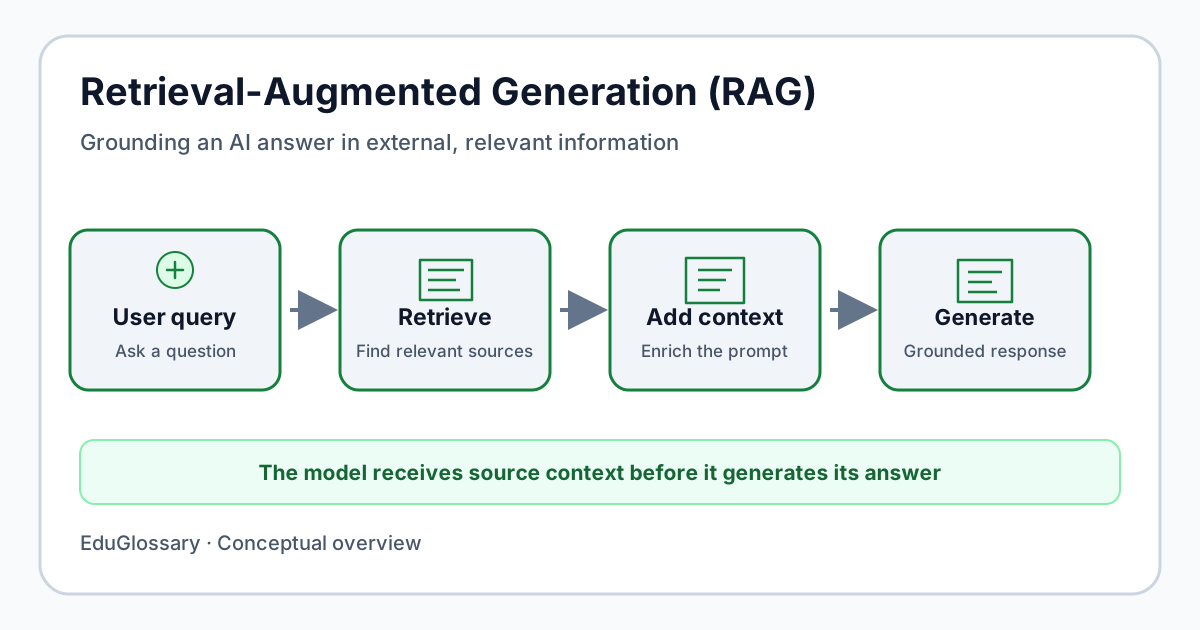
Retrieval-augmented generation, commonly called RAG, is an architecture that connects a generative AI model with external knowledge sources. Instead of relying only on what the model learned during training, a RAG system searches for relevant information at the moment a question is asked and feeds that information into the model alongside the user’s query. This gives the model fresh context to work with, making its responses more grounded in the specific data you provide.
The name describes exactly what the system does. It retrieves information from an external source, augments the original prompt with that information, and then generates a response using everything it has been given. The result is a system that can draw on current, domain-specific, or private data without requiring the underlying model to be retrained.
Why Do AI Models Need External Knowledge?
Large language models are trained on massive collections of text — books, articles, websites, and other publicly available material. This training gives them broad language skills and general knowledge, but it also introduces several limitations.
Knowledge cutoff. Every model has a training cutoff date. Anything that happened after that date is invisible to the model unless it is explicitly fed that information at runtime.
Private or organization-specific information. Most models have never seen your company’s internal documents, your product documentation, or your proprietary research. If you want an AI assistant that can answer questions about your specific business, the model needs access to that data.
Domain expertise. General-purpose models may understand broad concepts, but they often lack the depth required for specialized fields. A medical professional needs answers grounded in current clinical guidelines, not general summaries that may be outdated or incomplete.
Factual grounding. Models generate text by predicting likely next tokens. This means they can produce confident-sounding answers that are factually incorrect — a problem known as hallucination. Providing source material gives the model concrete information to work from, reducing the chance of fabricated details.
RAG addresses these gaps by keeping the model’s language abilities intact while supplying it with whatever external information is needed for each specific query.
How Does RAG Work?
A RAG system follows a straightforward pipeline. The basic flow looks like this:
-
User submits a query. The process begins when someone asks a question in natural language.
-
The system processes the query. The input may be cleaned or transformed to make it easier to search.
-
The retrieval system searches the knowledge base. The query is used to find relevant documents or passages from an external source. This source might be a vector database, a traditional search index, an API, or even the open web.
-
Relevant information is selected. The system identifies the most useful pieces of retrieved content, often ranking results by relevance.
-
Retrieved context is added to the input. The original query and the retrieved information are combined into a single prompt.
-
The LLM generates a response. The language model reads the augmented prompt and produces an answer based on both the query and the retrieved context.
-
Citations may be included. Some systems return source references alongside the generated answer, allowing users to verify where the information came from.
The entire pipeline runs in real time for each user query. This is what makes RAG different from approaches that modify the model itself — the knowledge comes from outside, and it can be updated independently of the model.
The Main Components of a RAG System
Most RAG systems share several core components:
Knowledge source. The external repository of information the system draws from. It could be PDFs, databases, internal wikis, or live APIs. The quality of the knowledge source directly affects the quality of the output.
Embedding model. Systems often convert text into numerical representations called embeddings. An embedding model produces a vector — a list of numbers that captures the semantic meaning of text. Similar texts receive similar vectors.
Retriever. This component searches the knowledge base for relevant information. It converts the user’s query into an embedding and finds matching content. Modern retrievers use semantic search rather than simple keyword matching.
Search or retrieval layer. This layer handles the actual lookup process. It may involve keyword search, semantic search, hybrid approaches, or direct database queries depending on the use case.
Integration layer. Also called the orchestration layer, this component coordinates the entire pipeline. It manages data flow between the retriever, knowledge base, and generator, ensuring the retrieved context is formatted correctly for the LLM.
Generator. The generative AI model that produces the final response. In most cases this is a large language model that receives the augmented prompt and generates text based on both the query and retrieved context.
Optional reranker. More sophisticated systems include a reranking step after initial retrieval to ensure the most relevant content makes it into the final prompt.
Not every RAG implementation includes all of these components. Simple systems might combine the retriever and search layer into a single step.
RAG Architecture Explained
At its core, RAG architecture follows a simple data flow:
User Query → Retrieval → Relevant Context → LLM → Generated ResponseThe user query arrives as natural language text. The retrieval stage searches for relevant information, returning document chunks ranked by relevance. The relevant context is carefully selected to fit within the LLM’s context window — this step is critical, as poor context selection leads to poor responses. The LLM receives the augmented prompt and generates a response. The generated response is delivered to the user, potentially including citations or source links.
The architecture can be extended with multiple retrieval passes or feedback loops, but the basic flow remains the same.
RAG vs. a Traditional LLM
| Aspect | Traditional LLM | RAG System |
|---|---|---|
| Information source | Training data only | Training data plus external knowledge base |
| External/private information | Cannot access | Can query proprietary or private data |
| Freshness | Limited to training cutoff date | Can access current information |
| Retrieval step | None | Searches knowledge base before generating |
| Source grounding | No built-in mechanism | Can cite and reference source material |
| Knowledge updates | Requires retraining | Update knowledge base independently |
| Typical use cases | General conversation, creative writing | Domain-specific Q&A, fact-based assistance |
A traditional LLM generates responses based entirely on patterns it learned during training. It has no mechanism to look up current information or access private documents.
RAG adds a retrieval step that bridges this gap. Before generating a response, the system searches for relevant information and incorporates it into the prompt. This doesn’t change the model itself — it changes what the model sees at inference time.
It’s important to note that RAG doesn’t automatically make a model more accurate. If the retrieval step returns irrelevant or incorrect information, the generated response will reflect those problems.
RAG vs. Fine-Tuning
RAG and fine-tuning share a common goal — improving model performance for specific tasks — but they work in fundamentally different ways.
RAG retrieves information at inference time. The system searches an external knowledge base and feeds the results to the model. The model’s parameters remain unchanged. If you need to update the knowledge, you modify the external data source — no retraining required. This makes RAG ideal for scenarios where information changes frequently or where the knowledge base is too large or sensitive to include in model training.
Fine-tuning adjusts the model itself. During fine-tuning, the model’s parameters are updated using a specialized dataset. This changes how the model behaves, making it better suited to a particular task, domain, or style. Fine-tuning requires computational resources and careful dataset preparation. Once fine-tuned, the model carries those changes permanently unless further training is applied.
Fine-tuning is useful when you want to change the model’s behavior, adapt its output style, or teach it domain-specific reasoning patterns. It’s particularly valuable when the task requires the model to internalize knowledge rather than retrieve it.
The two approaches are not mutually exclusive. Many production systems use both — fine-tuning to establish baseline capabilities and RAG to provide current, domain-specific information.
Common RAG Use Cases
Documentation assistants. Companies maintain extensive documentation for their products and services. A RAG-powered assistant can help users find answers by searching through that documentation.
Enterprise knowledge assistants. Large organizations often have information scattered across internal wikis, HR policies, technical guides, and compliance documents. A RAG system can unify access to this information.
Customer support systems. Customer-facing chatbots can use RAG to access product manuals, troubleshooting guides, and policy documents, providing accurate answers about specific products.
Research assistants. Researchers can use RAG to retrieve relevant papers, reports, and datasets, then help summarize and explain the findings.
Internal policy and compliance. Organizations can use RAG to help employees understand and apply complex regulatory requirements.
Product knowledge systems. E-commerce platforms can connect product catalogs to conversational interfaces, allowing customers to ask detailed questions about products.
These examples share a common pattern: they involve domain-specific information that changes over time and benefits from natural language interaction.
Benefits of RAG
Access to external and domain-specific information. RAG allows models to draw on knowledge that was never part of their training data, including private company documents and recent news.
Easier knowledge updates. When information changes, you update the knowledge base rather than retraining the model. A documentation update that takes minutes through RAG might require hours or days with fine-tuning.
Better grounding when retrieval works well. When the retrieval system finds relevant, accurate information, the generated response can be more factually grounded than one produced from training data alone.
Potential for source attribution. RAG systems can include citations or references to retrieved sources, giving users visibility into where information came from.
Greater control over knowledge sources. Organizations can curate exactly which information the system has access to, adding, removing, or updating sources without touching the model.
Usefulness with proprietary information. RAG enables AI assistance using data that cannot be shared publicly or included in model training, which is important for industries with strict data privacy requirements.
Limitations and Challenges
Poor retrieval leads to poor answers. The quality of the generated response depends heavily on the quality of the retrieved information. If the retrieval system returns irrelevant or incorrect documents, the model will incorporate those problems.
Outdated or incorrect source documents. A RAG system can only work with whatever information exists in its knowledge base. Regular maintenance is essential.
Irrelevant retrieved context. Even with good retrieval, the system may return passages only tangentially related to the query, which can confuse the model.
Incomplete retrieval. The system may fail to find all relevant information, especially for complex or multi-faceted queries.
Context window constraints. LLMs have limited context windows. When the knowledge base is large, important information may be excluded to fit within the window.
Chunking challenges. Documents are typically split into smaller pieces before being indexed. Chunks that are too large may contain irrelevant information; chunks that are too small may lack context.
Embedding and search limitations. Embedding models capture semantic similarity but don’t perfectly represent meaning. Hybrid approaches combining semantic and keyword search often perform better.
Latency. RAG adds overhead compared to simple model inference. The retrieval step requires searching the knowledge base, which takes time.
Infrastructure and maintenance costs. Running a RAG system requires more infrastructure than deploying a model alone.
Security and access control. External knowledge bases may contain sensitive information. Ensuring the RAG system only retrieves authorized content requires careful implementation.
Hallucinations can still occur. While RAG can reduce the risk of hallucinations by grounding generation in retrieved information, it does not eliminate the possibility. The model may misinterpret retrieved content, combine information incorrectly, or generate details that go beyond what the sources support. RAG is not automatically more accurate in every situation.
RAG, Embeddings, and Vector Databases
Modern RAG systems often use embeddings and vector databases, but these are tools rather than requirements.
Documents become chunks. Raw documents are typically split into smaller pieces called chunks. Chunking makes the content easier to search and ensures individual pieces fit within the context window.
Chunks become embeddings. An embedding model converts each text chunk into a vector — a list of numbers representing the semantic content. Similar texts receive similar vectors.
Vectors are stored in a vector database. A vector database is a specialized storage system designed to hold and search embeddings efficiently. It indexes the vectors so that similarity searches can be performed quickly across millions of documents. For a broader view of how these concepts connect, see the AI & Data learning path.
Semantic similarity search. Unlike traditional keyword search, semantic search finds documents that are conceptually related to the query even if they use different words.
However, RAG does not require vector databases or embeddings. Some systems use traditional keyword search, full-text search engines, or direct database queries. Hybrid approaches combine multiple retrieval methods. The fundamental principle of RAG — retrieving relevant information before generating a response — remains the same regardless of the retrieval technology used.
What Is Agentic RAG?
Agentic RAG extends the basic RAG pattern by incorporating AI agents — systems that can plan, reason, and take action rather than simply retrieving and generating. While traditional RAG follows a fixed linear pipeline, agentic RAG introduces flexibility and adaptation.
An agent might decide to search multiple sources instead of one, refine the query based on initial results, or break a complex question into sub-questions that are answered separately and then synthesized. Key capabilities include:
Multiple retrieval steps. Instead of a single search, the agent may perform iterative retrieval, using results from earlier searches to refine later queries.
Tool use. Agentic systems can call external tools beyond simple retrieval, such as querying databases, executing code, or accessing APIs.
Adaptive workflows. The agent can decide which retrieval strategies to use, when to stop searching, and how to combine information from different sources.
Memory and context management. Agents can maintain context across multiple interactions, enabling more coherent multi-turn conversations.
Agentic RAG is particularly useful for complex scenarios where a single retrieval step is insufficient. However, it introduces additional complexity and cost. More agents mean more computation, more latency, and more opportunities for errors. It is not always the better choice — simple queries often work well with basic RAG, and the extra overhead may not be justified.
Frequently Asked Questions
What does RAG stand for?
RAG stands for Retrieval-Augmented Generation. The name describes the three key steps: retrieving relevant information, augmenting the query with that information, and generating a response.
Does RAG retrain an AI model?
No. RAG does not modify the model’s parameters. It provides the model with additional context at inference time by retrieving relevant information from an external knowledge base.
Does RAG eliminate AI hallucinations?
No. RAG can reduce the risk of hallucinations by grounding generation in retrieved information, but it cannot guarantee accuracy. Incorrect retrieval, incomplete sources, or generation errors can still produce inaccurate answers.
Does RAG require a vector database?
No. While many implementations use vector databases for semantic search, RAG can work with keyword search, full-text search engines, database queries, or hybrid approaches.
What is the difference between RAG and fine-tuning?
RAG retrieves external information at inference time without changing the model, while fine-tuning adjusts the model’s parameters through additional training. RAG is better for accessing current information; fine-tuning is better for adapting behavior or style. The two approaches can be used together.
Is RAG useful for private documents?
Yes. RAG is particularly valuable for accessing private or proprietary information because the documents remain in your own systems rather than being incorporated into model training.
This article is part of the EduGlossary AI & Data category. Explore related topics in Machine Learning, Natural Language Processing, and Deep Learning for more foundational concepts. For a structured learning path, visit the AI & Data hub.