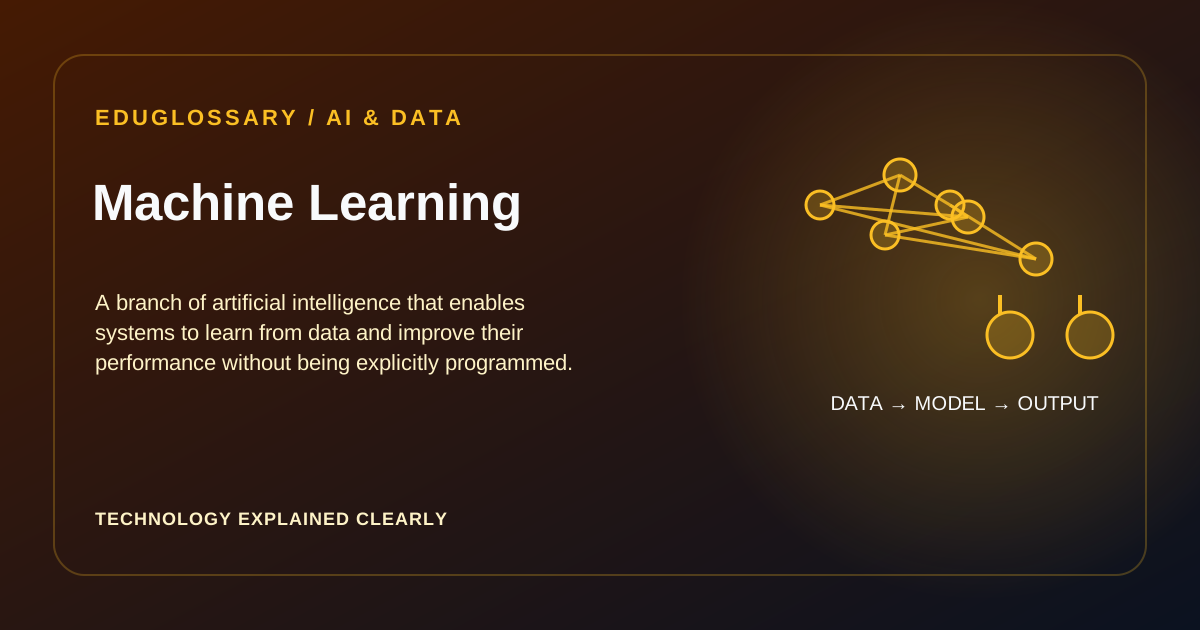
Machine Learning (ML) is an approach within artificial intelligence where computers learn to recognize patterns from data and make decisions or predictions without explicit rule-based instructions. Instead of being manually written by a programmer, an ML model learns the relationship between inputs and outputs from historical data examples, then applies those patterns to new, unseen data.
Traditional programming follows a deterministic approach: input + rules = output. Machine learning inverts this: input + output = rules. The system discovers the rules (patterns) by analyzing many examples of inputs and their correct outputs.
The ML Workflow
Building a machine learning model typically follows a pipeline:
-
Data collection — gather relevant, representative data from the problem domain. Quality matters more than quantity; biased or incomplete data produces biased or inaccurate models.
-
Data preparation — clean the data, handle missing values, remove outliers, and transform features into a format the model can use. This often takes 60-80% of the total project time.
-
Model selection — choose an algorithm suited to the problem type and data characteristics. Simple problems may need simple models; complex patterns may require deep learning.
-
Training — feed the prepared data to the algorithm so it learns patterns by adjusting its internal parameters. Training involves minimizing a loss function through optimization algorithms.
-
Evaluation — test the model on data it has never seen to measure how well it generalizes. Metrics include accuracy, precision, recall, F1-score, and ROC-AUC depending on the problem type.
-
Deployment — integrate the trained model into an application where it can make predictions on live data. This requires monitoring for performance degradation over time.
This pipeline is iterative. Poor evaluation results often send developers back to collect more data, engineer better features, or try a different algorithm.
Three Learning Paradigms
Supervised learning uses labeled datasets — each training example includes both the input and the correct output. The model learns to map inputs to correct outputs. Common tasks include classification (assigning categories, like spam vs. not spam) and regression (predicting continuous values, like house prices). This is the most widely used paradigm in practice.
Examples: Email spam detection, medical diagnosis, stock price prediction, image classification.
Unsupervised learning works without labeled outputs. The algorithm finds hidden structures, groupings, or patterns in the data on its own. Customer segmentation, anomaly detection, and dimensionality reduction are typical use cases. The model discovers what is interesting about the data rather than what you told it to look for.
Examples: Customer segmentation, recommendation systems, anomaly detection, topic modeling.
Reinforcement learning involves an agent that learns by interacting with an environment. It takes actions, receives rewards or penalties, and gradually learns a strategy (policy) that maximizes cumulative reward. Game-playing AI, robotics, and resource optimization are common applications. This paradigm differs from the others because learning happens through experience rather than from a static dataset.
Examples: Game playing (AlphaGo), robotic control, autonomous vehicles, resource management.
Common Algorithms
Supervised Learning Algorithms
- Linear Regression: Predicts continuous values by fitting a line to data
- Logistic Regression: Predicts probabilities for binary classification
- Decision Trees: Tree-like models that make decisions through hierarchical questions
- Random Forests: Ensemble of decision trees for improved accuracy
- Support Vector Machines: Finds optimal boundaries between classes
- Neural Networks: Layers of interconnected nodes for complex pattern recognition
- Gradient Boosting: Sequential trees that correct previous errors (XGBoost, LightGBM)
Unsupervised Learning Algorithms
- K-Means Clustering: Groups data into K clusters based on similarity
- Hierarchical Clustering: Builds nested clusters in a tree structure
- Principal Component Analysis (PCA): Reduces dimensionality while preserving variance
- Autoencoders: Neural networks that learn compressed representations
- Apriori Algorithm: Finds associations between variables
Reinforcement Learning Algorithms
- Q-Learning: Learns action-value functions for decision making
- Policy Gradient: Optimizes policies directly through gradient ascent
- Deep Q-Networks (DQN): Combines Q-learning with deep neural networks
- Actor-Critic Methods: Combines value-based and policy-based approaches
Overfitting and Underfitting
A central challenge in ML is generalization — how well a model performs on new data it has not seen before.
Overfitting occurs when a model learns the training data too closely, including its noise and quirks. It performs well on training data but poorly on new data. A model that has memorized the training set rather than learning underlying patterns is overfit.
Signs of overfitting:
- High training accuracy, low validation accuracy
- Model performs well on training data but fails on real-world data
- Complex model with many parameters relative to training data size
Underfitting is the opposite: the model is too simple to capture the real patterns in the data, resulting in poor performance on both training and new data.
Signs of underfitting:
- Low accuracy on both training and validation data
- Model is too simple for the problem complexity
- High bias, low variance
The balance between these two extremes is managed through techniques like cross-validation (testing the model on different subsets of data), regularization (penalizing unnecessary complexity), and collecting more diverse training data.
Feature Engineering
Feature engineering is the process of creating meaningful input variables from raw data. Good features often matter more than sophisticated algorithms.
Common techniques:
- Normalization/Scaling: Rescaling features to similar ranges
- Encoding: Converting categorical variables to numbers
- Interaction features: Creating new features from combinations of existing ones
- Polynomial features: Adding powered versions of features
- Dimensionality reduction: PCA, feature selection to reduce complexity
Model Evaluation Metrics
Classification metrics:
- Accuracy: Proportion of correct predictions
- Precision: Proportion of positive predictions that are correct
- Recall: Proportion of actual positives correctly identified
- F1-Score: Harmonic mean of precision and recall
- ROC-AUC: Area under the receiver operating characteristic curve
Regression metrics:
- Mean Absolute Error (MAE): Average absolute differences
- Mean Squared Error (MSE): Average squared differences
- R-squared: Proportion of variance explained by the model
Real-World Applications
ML is used across many sectors:
- Healthcare: Medical diagnosis from images, drug discovery, personalized treatment
- Finance: Fraud detection, credit scoring, algorithmic trading
- Retail: Recommendation systems, demand forecasting, dynamic pricing
- Transportation: Autonomous vehicles, route optimization, traffic prediction
- Manufacturing: Predictive maintenance, quality control, supply chain optimization
- Entertainment: Content recommendations, ad targeting, game AI
- Agriculture: Crop yield prediction, pest detection, precision farming
The combination of large-scale available data and modern computational power makes ML increasingly practical across domains that were previously difficult to automate.
Challenges and Limitations
Data quality: Garbage in, garbage out. Biased or incomplete data produces biased models.
Interpretability: Complex models like deep neural networks can be difficult to explain, creating trust and regulatory challenges.
Computational cost: Training large models requires significant compute resources and energy.
Adversarial attacks: Small perturbations to input can cause incorrect predictions, creating security vulnerabilities.
Concept drift: Models degrade as real-world data distributions change over time, requiring retraining.
Future Trends
AutoML: Automated machine learning tools that simplify model selection and tuning.
Federated learning: Training models across distributed devices without sharing raw data.
Explainable AI: Methods to make model decisions more interpretable and transparent.
Edge AI: Running ML models on devices rather than cloud servers.
Neuromorphic computing: Hardware designed to mimic brain architecture for efficient ML.
Frequently Asked Questions
What is the difference between AI, Machine Learning, and Deep Learning?
Think of them as nested subsets: AI is the broad field of making machines intelligent. Machine Learning is a subset of AI where systems learn from data rather than following explicit rules. Deep Learning is a subset of ML using multi-layer neural networks to learn complex patterns. All deep learning is ML; all ML is AI; but not all AI is ML (e.g., rule-based expert systems).
How much data do I need for machine learning?
It depends on the problem complexity and algorithm. Simple problems (linear regression) can work with hundreds of examples. Deep learning typically needs thousands to millions of labeled examples. More data generally improves performance, but quality and representativeness matter more than raw quantity. Techniques like transfer learning (using pre-trained models) can reduce data requirements significantly.
What is overfitting and how do I prevent it?
Overfitting happens when a model memorizes training data (including noise) instead of learning generalizable patterns. It performs well on training data but poorly on new data. Prevention: more diverse training data, regularization (L1/L2, dropout), cross-validation, simpler models, early stopping, and data augmentation.
Do I need a GPU for machine learning?
For training deep learning models (neural networks), GPUs accelerate computation dramatically (10-100x faster). For traditional ML (decision trees, linear models) or inference (using trained models), CPUs are often sufficient. Cloud services (AWS, GCP, Azure) provide GPU instances on-demand if you don’t have local hardware.
What is transfer learning?
Transfer learning uses a model pre-trained on a large dataset (e.g., ImageNet for images, BERT for text) and fine-tunes it on your smaller, specific dataset. This leverages learned features from the big dataset, dramatically reducing training time and data requirements. It’s the standard approach for most practical deep learning today.
Can machine learning make mistakes?
Yes, ML models can make errors. They learn from data, so biased or incomplete data leads to biased predictions. Understanding model limitations and implementing human oversight for critical decisions is essential.
Evaluating a model against the actual decision
Model evaluation should reflect the cost of different errors. In a fraud-screening system, a false negative may allow abuse while a false positive can block a legitimate customer. In a maintenance forecast, missing an imminent failure can be more costly than raising an extra inspection alert. Select metrics and decision thresholds with the people who understand those consequences, and document the expected workload created by the model’s recommendations.
A baseline is essential. Compare the model to a simple rule, existing process, or previous-period forecast. Use an evaluation split that reflects how predictions will be used; for future-facing problems, time-based testing is often more realistic than a random split. Prevent leakage by ensuring that features do not contain information derived from the target or unavailable at prediction time. Check whether duplicated or related examples leak across train and test data.
From prototype to production
A model in a notebook is not yet a reliable service. Production needs a repeatable pipeline for data validation, training, evaluation, packaging, deployment, logging, and rollback. Version the dataset, feature transformations, model, and configuration so a prediction can be traced to the version that produced it. Monitor latency, input distributions, missing values, prediction distributions, and delayed outcome labels.
Retraining should have a reason and acceptance criteria rather than happen automatically on an arbitrary schedule. New data can improve coverage, but it can also encode a temporary anomaly or new bias. Compare a candidate model with the current production model before promoting it.
Privacy and explainability
Consider whether the feature set includes sensitive or proxy variables, whether data retention is justified, and whether users can contest a consequential decision. Explainability techniques can help diagnose or communicate model behavior, but a simplified explanation should not be presented as a complete account of every internal computation. Keep a human decision-maker responsible when errors can materially affect rights, safety, or access to essential services. Machine learning is a modeling approach; trustworthy use requires engineering and governance around the model.