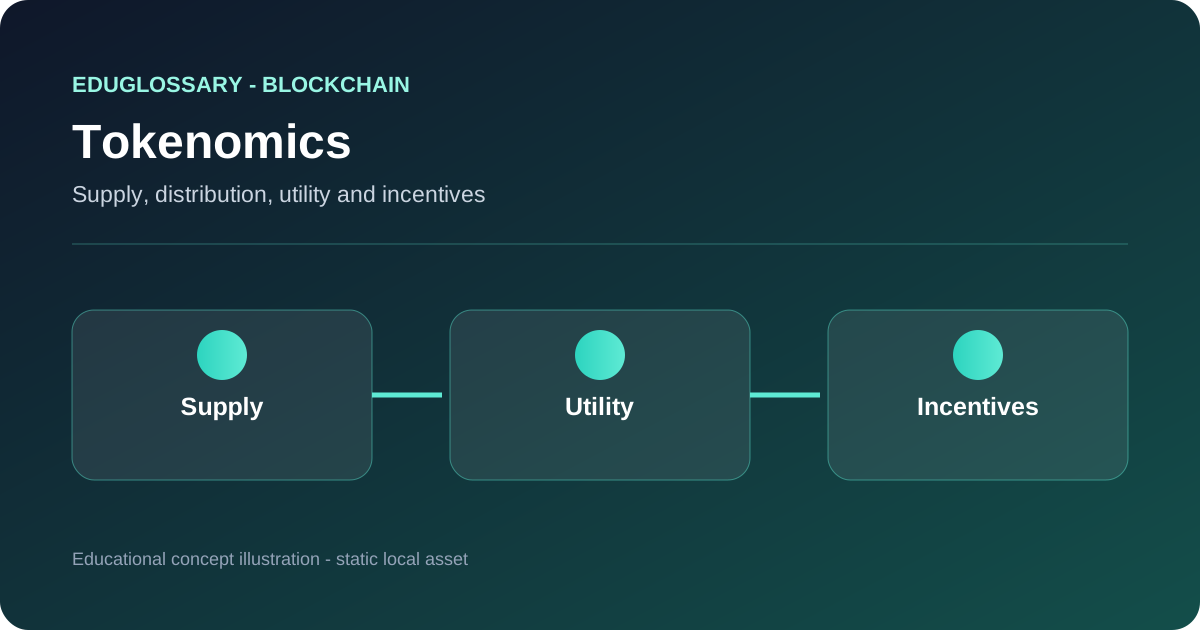
Tokenomics is the study and design of the economic rules around a digital token. It covers what the token represents, how many units exist, how new units are issued, how units are distributed, what the token is used for, and how incentives affect participants. The term is often used for a project plan, but tokenomics is better understood as an evolving system of rules implemented through protocols, contracts, organizations, and markets.
What Tokenomics Includes
Important questions include:
- Supply: How many units exist now, and is there a total or maximum supply?
- Issuance: Are new units minted for validators, liquidity providers, users, a treasury, or another purpose?
- Distribution: Who received units at launch, and are allocations public, vested, or restricted?
- Utility: Does the token pay fees, secure a network, access a service, represent governance, or serve as collateral?
- Unlocks: When can investors, teams, or treasuries transfer units that were initially locked?
- Destruction: Can units be burned, redeemed, or removed from circulation, and under what rules?
- Governance: Who can change supply, parameters, upgrades, or treasury decisions?
These details interact. A token may have a small circulating supply while many units are scheduled for future release. A protocol may advertise a fixed maximum supply but still permit governance to change the rule. A token may have voting rights but little practical influence if a small group controls most of the voting power.
Network and Application Tokens
The native asset of a blockchain can pay transaction fees, reward validators, and help secure the network. In a Proof of Stake system, holders may stake it directly or through a service, while the protocol uses the economic cost of dishonest behavior as part of its security model. The relationship between Proof of Stake and token supply is therefore a protocol-security question, not only a market question.
Application tokens are issued by smart contracts on an existing chain. They might coordinate governance, distribute incentives, provide access, or represent a claim within an application. A token can be useful without representing equity in a company, and a name that suggests utility does not establish a legal right. The actual behavior comes from the contract, documentation, governance, and applicable law.
Incentives and Emissions
Protocols often use token emissions to attract liquidity, reward activity, subsidize network security, or bootstrap a user community. Emissions can make participation cheaper in the short term, but they also increase supply and may create sell pressure or dependence on continuing rewards. A sustainable design explains who funds rewards, what behavior they encourage, and what happens when incentives decline.
Vesting and unlock schedules help separate a token’s current supply from its future supply. Analysts often compare market capitalization, based on circulating units, with fully diluted valuation, based on a larger future supply. Neither measure explains whether unlocks will be absorbed by demand, whether recipients will sell, or whether the token has meaningful utility.
Governance and Concentration
Token-based governance can let holders vote on parameters, upgrades, treasury spending, or community proposals. The design may use one-token-one-vote, delegated voting, quadratic rules, or other mechanisms. Concentrated ownership, delegated voting, low participation, and emergency administrator powers can mean that formal governance differs from practical control.
A Smart Contract can automate token transfers, vesting, staking, and treasury rules, but code can contain vulnerabilities or upgrade paths. Governance can also change a contract’s behavior. A token’s economic design should therefore be read together with its implementation, security model, and social process.
Evaluating Tokenomics Carefully
Useful analysis separates facts from promises. Check the supply schedule, circulating-supply definition, allocation percentages, wallet concentration, unlock dates, emission formula, fee flows, governance powers, and contract permissions. Ask whether the token is necessary for the service or mainly used as an incentive. Check whether a stablecoin, bridge, oracle, or centralized custodian creates an important dependency.
Tokenomics cannot guarantee adoption, security, or value. Market capitalization is only one measurement, and a token can have a high reported value while having weak liquidity or limited rights. No distribution chart or forecast removes technical, operational, legal, or market risk.
Circulating Supply and Unlocks
A token’s circulating supply is a methodology-driven estimate, not simply every unit ever created. Some units may be locked in vesting contracts, held by a treasury, reserved for future incentives, or excluded for other documented reasons. The definition should be checked before using circulating supply in a market-cap calculation.
Unlock schedules are important because future releases can change the number of units available to holders. The effect depends on who receives the tokens, what rights they have, how quickly they can transfer them, and how the market absorbs additional supply. An unlock date is therefore a supply event, not an automatic forecast of a price movement.
Utility and Value Capture
Token utility describes what participants can do with the token, while value capture asks whether activity in a system creates a mechanism that benefits token holders. These concepts are often conflated.
A token may be required to pay network fees or participate in governance without giving holders a legal claim on protocol revenue. Another token may receive fee distributions under explicit rules. A protocol can also have substantial usage while its token has limited economic rights. Reviewing the actual mechanism is more reliable than assuming that “utility” means financial value flows to holders.
Incentive Design
Tokens are frequently used to reward behaviors such as validating transactions, supplying liquidity, using an application, or participating in governance. Incentives can help a network bootstrap, but their economics should be examined over time.
Questions include who funds the rewards, how quickly new units enter circulation, whether rewards are concentrated among a small group, and what happens when emissions are reduced. A system that depends heavily on continuous token rewards may behave differently after subsidies decline.
Treasury and Governance
Treasuries can hold tokens, stablecoins, or other assets used to fund development and operations. Tokenomics analysis should consider who controls the treasury and what governance process can move or spend it. A large nominal treasury can also be volatile if much of its value is held in the project’s own token.
Governance rights deserve similar attention. Voting power may be weighted by token balance, delegated to representatives, modified by quorum rules, or constrained by a multisignature or administrator. Formal voting power and practical control are not always the same.
Contracts, Permissions, and Upgradeability
Tokenomics exists partly in documentation and partly in software. A token contract may include mint, burn, pause, blacklist, transfer restrictions, upgrade, or administrator functions. Not every function is harmful; some are necessary for compliance, recovery, or system operations. The important question is who can invoke the function, under what conditions, and whether the permission can be changed.
When evaluating a token, readers should distinguish the published economic design from the actual deployed contract. A discrepancy between the two is an important finding.
A Practical Tokenomics Checklist
A complete review can record current supply, maximum or target supply, issuance schedule, burn rules, allocation by stakeholder, vesting and unlock dates, token utility, governance rights, treasury control, contract permissions, and major dependencies. It can then compare these facts with observed network usage and token-holder concentration.
Tokenomics is most useful as a framework for understanding incentives and supply mechanics. It should not be treated as proof of future adoption, profitability, security, or price performance. Market conditions and protocol behavior can change, while legal rights depend on the specific arrangement and jurisdiction.
Reading a Token Allocation
A token allocation chart is only useful when its categories are clearly defined. “Team,” “community,” “treasury,” “investors,” and “ecosystem” can have different vesting rules and transfer restrictions. An allocation percentage without a release schedule does not show when those units can actually enter circulation.
A careful review combines allocation, vesting, unlock dates, and control rights. It should also identify whether insiders or large holders can influence governance or market liquidity. Concentration can matter even when the published allocation looks diversified.
Supply Metrics Should Be Consistent
Circulating supply, total supply, maximum supply, and fully diluted valuation answer different questions. Mixing them in one calculation can create an incorrect impression of dilution.
For example, a market-cap ranking based on circulating supply should not be compared directly with a valuation based on maximum supply without clearly labeling the difference. The underlying supply definitions should come from the same source or be reconciled before comparison.
Tokenomics and Real Usage
Tokenomics should be evaluated alongside actual protocol behavior. A token may have sophisticated incentives but limited usage, while another may have simpler economics and substantial network activity. Metrics such as active addresses, transaction activity, fees, liquidity, or application usage can provide context, but they also require careful methodology.
The strongest educational approach treats tokenomics as one layer of a broader system: protocol design, governance, security, user incentives, supply mechanics, and legal rights. No single metric can summarize the entire system.
Is tokenomics the same as a token price forecast?
No. Tokenomics describes design and incentives. It may help explain supply changes and participant behavior, but it cannot predict future prices.
Does a fixed supply guarantee scarcity or value?
No. Demand, utility, distribution, liquidity, governance, and substitutes also matter. A fixed number of units does not create a guaranteed market value.
Are token holders shareholders?
Usually not. Token rights vary, and ownership of a token generally does not automatically provide equity, dividends, or legal control over an issuer.
Reading allocation and unlock schedules
Token allocation tables should distinguish initial allocation, circulating supply, vesting, future emissions, treasury holdings, and units subject to special transfer or burn rules. A percentage assigned to a team or investor does not reveal when those units become transferable; the unlock schedule and any on-chain restrictions are equally important. Compare the published schedule with contract behavior and on-chain events where possible, and date the snapshot because circulating supply can change.
Governance rights and economic rights should also be separated. A token may vote on parameters without giving holders a claim on protocol revenue; another may be required for fees or collateral but provide no formal governance vote. Avoid assuming that a token’s stated utility automatically creates demand or value.
A transparent tokenomics review should test the incentives at different stages: launch, periods of high issuance, falling demand, low liquidity, and changes to governance. Identify who can change emissions, mint additional units, pause transfers, or alter fee flows. These permissions and dependencies are more informative than a simple maximum-supply figure. Model scenarios transparently and label assumptions rather than presenting projected supply or price outcomes as facts.