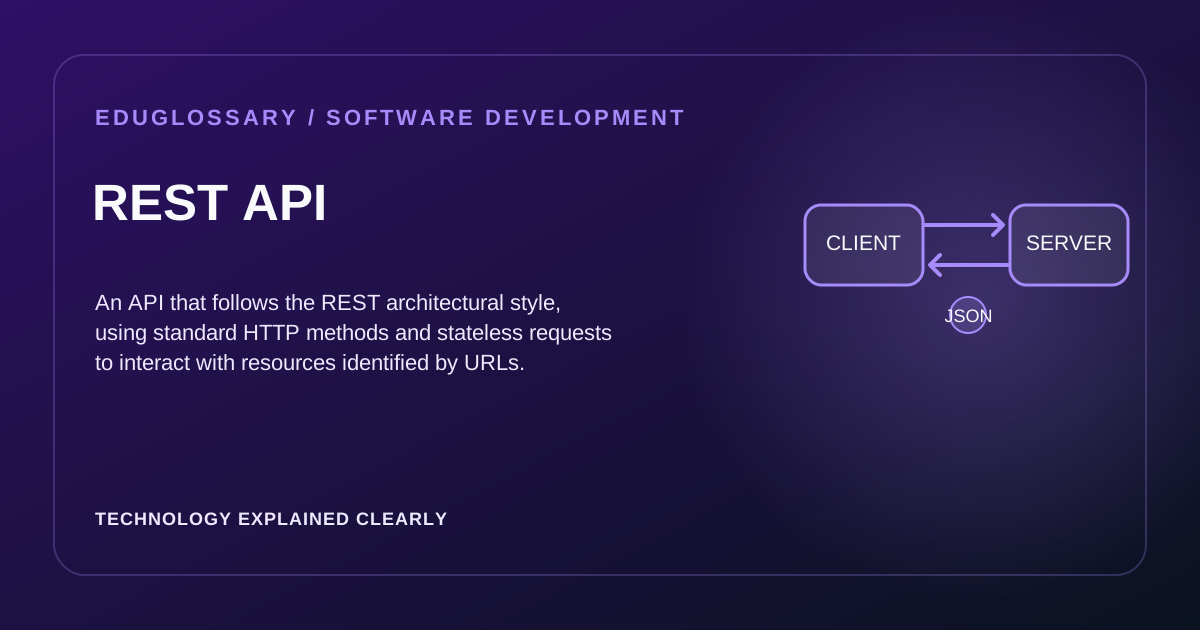
A REST API (Representational State Transfer Application Programming Interface) is an API that adheres to the REST architectural principles defined by Roy Fielding in his 2000 doctoral dissertation. REST APIs use standard HTTP methods, stateless communication, and resource-oriented URLs, making them the most widely implemented API style on the web.
Most public APIs you interact with — Twitter/X API, GitHub API, Stripe payments, weather data services — are REST APIs. Their popularity comes from simplicity: they use the existing HTTP protocol without requiring special client libraries or proprietary protocols.
Core Principles
Resource-based. Every entity (user, order, product) is identified by a unique URL. The URL represents the resource, not an action.
GET /users/42 → retrieve user 42PUT /users/42 → update user 42DELETE /users/42 → delete user 42GET /users/42/orders → retrieve orders belonging to user 42Stateless. Each request contains all the information needed to process it. The server does not store client session state between requests. This simplifies server design and improves scalability — any server instance can handle any request.
Standard HTTP methods. REST maps CRUD operations to HTTP verbs:
| Operation | HTTP Method | Idempotent? |
|---|---|---|
| Create | POST | No |
| Read | GET | Yes |
| Update (full) | PUT | Yes |
| Update (partial) | PATCH | No |
| Delete | DELETE | Yes |
Idempotency means calling the method multiple times produces the same result as calling it once — critical for safe retries in unreliable networks.
Uniform interface. Resources are manipulated through a consistent, standardized interface. Clients do not need to know implementation details — only the URL structure and HTTP methods.
REST API Response Format
REST APIs typically return data in JSON format:
{ "id": 42, "name": "Ada Lovelace", "created_at": "2026-01-15T10:30:00Z"}The response includes an HTTP status code indicating the outcome: 200 OK for success, 201 Created for successful resource creation, 404 Not Found for nonexistent resources, 422 Unprocessable Entity for validation errors.
Pagination, Filtering, and Sorting
REST APIs handling large collections use query parameters for pagination, filtering, and sorting:
GET /articles?page=3&limit=20&category=blockchain&sort=-published_dateCommon pagination patterns include offset-based (?page=2&limit=20) and cursor-based (?cursor=abc123&limit=20). Cursor-based pagination performs better at scale because it does not require the server to count and skip records.
Authentication
REST APIs authenticate requests through several standard mechanisms:
- API keys — a token passed in a header (
Authorization: Bearer abc123). Simple but less secure for browser-based apps. - OAuth 2.0 — a delegation framework that allows third-party apps to access resources on behalf of a user without sharing credentials. Used by social login flows and integrations.
- JWT (JSON Web Tokens) — a self-contained token carrying user claims, signed by the server. Enables stateless authentication since the server validates the token without a database lookup.
REST vs. GraphQL
| Property | REST | GraphQL |
|---|---|---|
| Endpoints | Multiple (one per resource) | Single endpoint |
| Data fetching | Server determines response shape | Client specifies exact fields needed |
| Over-fetching | Common (client receives more data than needed) | Eliminated (client requests only what it needs) |
| Versioning | Often required (/api/v1/, /api/v2/) |
Evolved through schema changes |
| Caching | Standard HTTP caching works easily | Requires additional tooling |
| Learning curve | Low | Moderate |
REST remains the default choice for most API projects due to its simplicity, mature tooling, and universal support. GraphQL excels when clients need flexible, nested data queries (e.g., dashboards with complex, varying data needs). For most applications, REST provides the best balance of simplicity, performance, and ecosystem support.
Best Practices
Use nouns for resource URLs, not verbs. /users not /getUsers. The HTTP method conveys the action.
Version your API from the start (/api/v1/). Breaking changes to a public API without versioning forces all clients to update simultaneously.
Return appropriate status codes. Do not return 200 OK with an error message in the body — use 4xx for client errors and 5xx for server errors.
Implement rate limiting. Protect your API from abuse by limiting requests per client per time window. Return 429 Too Many Requests with a Retry-After header when limits are exceeded.
Document thoroughly. Tools like OpenAPI (Swagger) generate interactive documentation from API specifications, making it easy for developers to understand and test your API.
Frequently Asked Questions
What is the difference between REST and RESTful?
Technically, REST (Representational State Transfer) is the architectural style defined by Roy Fielding. RESTful means an API follows REST principles. In practice, the terms are used interchangeably — a “REST API” is expected to be RESTful. True REST compliance includes HATEOAS (Hypermedia as the Engine of Application State), which few APIs fully implement.
Should I use PUT or PATCH for updates?
PUT replaces the entire resource — the client must send the complete representation. PATCH applies a partial update — the client sends only the fields to change. Use PUT when the client has the full object; use PATCH for partial updates (e.g., changing just an email address). PATCH is not idempotent in all implementations, so document the behavior clearly.
How do I handle versioning in a REST API?
Common approaches: URL versioning (/api/v1/users) — most visible, cacheable, easy to route. Header versioning (Accept: application/vnd.myapp.v1+json) — keeps URLs clean, requires clients to set headers. Query parameter (/users?version=1) — simple but mixes versioning with filtering. URL versioning is the most widely adopted and recommended for public APIs.
What HTTP status codes should a REST API return?
200 OK— successful GET, PUT, PATCH201 Created— successful POST (includeLocationheader with new resource URL)204 No Content— successful DELETE (no response body)400 Bad Request— malformed request body401 Unauthorized— missing or invalid authentication403 Forbidden— authenticated but not authorized for this resource404 Not Found— resource does not exist422 Unprocessable Entity— valid JSON but semantic validation failed429 Too Many Requests— rate limit exceeded500 Internal Server Error— unexpected server failure
How do I paginate large collections in a REST API?
Two main patterns: Offset-based (?page=2&limit=20) — simple but slow on large datasets (requires OFFSET). Cursor-based (?cursor=abc123&limit=20) — faster, stable pagination, works with real-time data. Cursor-based is preferred for large or frequently changing datasets. Always include pagination metadata in the response (total_count, next_cursor, has_more).
For a beginner-friendly overview: What is an API? A Complete Beginner’s Guide For general API concepts: API For broader context: Software Development hub
Designing predictable REST interfaces
A good REST API makes resource identity and state changes clear. Choose stable resource paths, use HTTP methods consistently, validate input at the server, and return status codes that reflect the outcome. Clients should not have to infer whether a request succeeded from a human-readable message. An error response should provide a stable machine-readable code and enough context to correct the problem without exposing stack traces, secrets, or internal implementation details.
Pagination is essential for collections that can grow. Cursor pagination often behaves more predictably than offset pagination when new records are inserted between requests, but the cursor must be opaque and validated. Document maximum page sizes, sorting rules, filters, and what happens when a requested sort field is not allowed. Never assume a client will obey a suggested limit.
Idempotency, retries, and concurrency
Networks fail, so clients retry requests. A GET can generally be repeated without changing server state. For a payment or order-creation endpoint, a repeated POST may create duplicates unless the service supports an idempotency key or equivalent deduplication strategy. Define how long such keys remain valid and how the server responds when a key is reused with a different payload. PUT is intended to replace a resource representation, while PATCH applies a partial update; the server should document how missing, null, and invalid fields are interpreted.
Concurrent updates need an explicit strategy. Optimistic concurrency controls such as ETags and conditional requests can help prevent a client from overwriting a newer change. For long-running work, return a job resource or another documented mechanism rather than leaving an HTTP request open indefinitely.
Secure and observable APIs
Authentication proves who or what is calling; authorization decides what that caller may do. Check permissions on every resource and action, rate-limit abuse-prone endpoints, validate content types and payload size, and avoid logging credentials or personal data. Monitor latency percentiles, error rates, throttling, and dependency failures. API versioning should be driven by compatibility needs, with a published deprecation window and migration guidance. Before release, run contract tests and verify behavior for expired credentials, missing fields, duplicate requests, large responses, and upstream outages.
Example: creating an order safely
Suppose a client sends a request to create a purchase. The API should authenticate the caller, verify that the caller can buy the requested item, validate quantities and prices on the server, and calculate the total using trusted data instead of accepting a client-supplied total. It should define how duplicate requests are handled and how the caller learns whether the order was created if the network drops before the response arrives. A payment should not be charged twice because the client retried after a timeout.
A robust design separates validation errors from authorization failures and temporary dependency errors. Responses should avoid exposing whether sensitive records exist to an unauthorized caller. For long-running work, return a status resource or another documented mechanism to let the client poll or receive completion notification.
Contract tests should cover valid and invalid payloads, expired credentials, permission boundaries, rate limits, pagination, and compatibility with older clients. Observe p95/p99 latency, timeout rate, error codes, and upstream dependency behavior. These operational signals help distinguish a faulty API from a healthy endpoint whose database or external service is degraded.
Design for clients that evolve independently
An API provider usually cannot update every consumer at the same moment. Make compatibility rules explicit: which fields are required, how unknown fields are handled, whether enum values may expand, and how errors are represented. Avoid changing the meaning of an existing field or silently changing units. When a breaking change is unavoidable, publish migration guidance, run both versions where practical, and collect evidence that active clients have moved before removing the old endpoint.
A well-designed API also controls resource usage. Enforce upper bounds on pagination, payload size, query complexity, and expensive actions. Apply authorization after resolving the resource and before returning sensitive fields. Protect idempotency records and ensure retries cannot trigger duplicate payments, messages, or jobs.
Finally, document service objectives and degradation behavior. A client should know whether a rate-limit response can be retried, how long an operation may take, and where to obtain a request identifier for support. These details reduce accidental overload and make integrations more resilient as different teams deploy on different schedules.