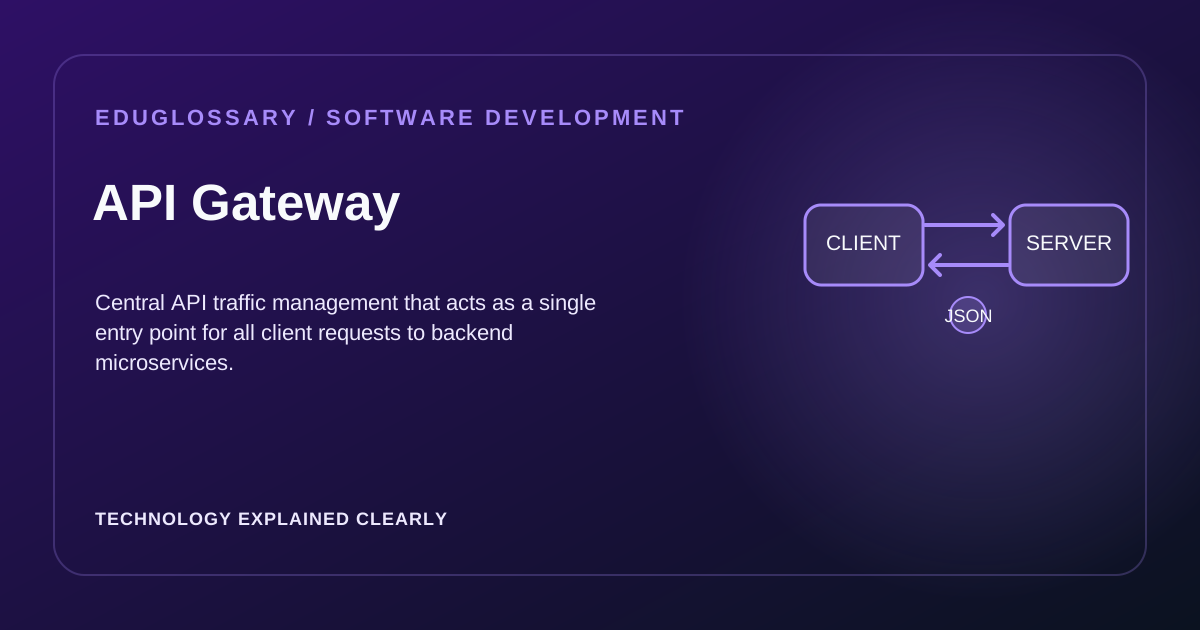
An API Gateway is an infrastructure layer that acts as a single entry point for all client requests to a collection of backend microservices. Instead of clients needing to know the address and protocol of each microservice directly, all requests are forwarded, converted, and routed through the gateway. This pattern simplifies client code and provides a centralized point for cross-cutting concerns that would otherwise need to be implemented in every service.
The API Gateway pattern emerged as microservices architectures grew in complexity. As organizations moved from monolithic applications to distributed systems with dozens or hundreds of microservices, the need for a unified entry point became apparent. Without a gateway, each client would need to maintain knowledge of every service endpoint, handle its own authentication, manage rate limiting, and deal with protocol differences — creating enormous complexity and redundancy.
Core Functions
Request routing is the fundamental gateway function. The gateway directs requests to the appropriate microservice based on URL path, header values, HTTP method, or other criteria. For example, requests to /api/users might route to a user service while /api/products routes to a product service. This abstraction means clients interact with a simple, predictable interface while the internal service topology can change without affecting clients.
Authentication and authorization is centralized at the gateway level. The gateway validates JWT tokens, API keys, OAuth credentials, or other authentication mechanisms before requests reach backend services. This centralizes security logic and prevents each microservice from implementing its own auth system — reducing duplication, ensuring consistent security policies, and simplifying service development. The gateway can also enforce role-based or attribute-based access controls.
Rate limiting protects backend services from being overwhelmed by excessive traffic. The gateway restricts the number of requests per unit time from a single client, IP address, or API key. This prevents abuse, ensures fair usage across clients, and protects services from denial-of-service conditions. Rate limits can be configured per-client, per-endpoint, or globally.
Protocol translation allows the gateway to accept requests in one protocol and convert them to another for internal communication. A common pattern is accepting HTTP/REST from clients while converting to gRPC for internal microservice communication. This allows internal services to use the most appropriate protocol for their needs while presenting a unified interface to external clients.
Request and response transformation enables the gateway to modify requests before forwarding them and responses before returning them. Request transformation might add authentication headers, transform data formats, or enrich requests with metadata. Response transformation might aggregate data from multiple services, format responses consistently, add caching headers, or compress responses.
Logging and monitoring is naturally centralized at the gateway since all traffic flows through it. The gateway can collect metrics on request latency, error rates, throughput, and client usage patterns. This provides a unified view of system health and performance, enabling better observability and troubleshooting.
Caching can be implemented at the gateway level to cache frequently requested responses. This reduces load on backend services, improves response times for clients, and can handle traffic spikes by serving cached responses. Cache invalidation strategies must be carefully designed to balance freshness with performance.
Popular API Gateway Solutions
Kong is an open-source API gateway written in Lua and NGINX, known for high performance and an extensive plugin ecosystem. It supports both on-premises and cloud deployment and offers features like rate limiting, authentication, logging, and request transformation through its plugin system. Kong Gateway and Kong Gateway Cloud are the primary editions.
AWS API Gateway is a fully managed service that handles authentication, rate limiting, caching, request transformation, and monitoring. It integrates seamlessly with other AWS services like Lambda for serverless functions, Step Functions for workflow orchestration, and DynamoDB for data storage. AWS API Gateway is particularly well-suited for serverless architectures.
Apigee (now part of Google Cloud) offers enterprise-grade API management with advanced analytics, developer portal capabilities, API monetization features, and comprehensive security. It is designed for large-scale enterprise API programs that need sophisticated management and governance.
Traefik is a modern reverse proxy and load balancer that automatically discovers services in dynamic environments like Docker and Kubernetes. It uses a configuration-free approach where service discovery drives routing decisions, making it popular in containerized and cloud-native deployments.
NGINX Plus provides API gateway capabilities through its commercial version, offering advanced routing, security features, load balancing, and monitoring. NGINX is widely used as a web server and reverse proxy, and NGINX Plus extends these capabilities for API management.
Azure API Management is Microsoft’s managed API gateway service that provides similar functionality to AWS API Gateway, integrating with the Azure ecosystem and supporting hybrid and multi-cloud scenarios.
API Gateway vs. Service Mesh
While both patterns address similar concerns around service communication, they operate at different layers and serve different purposes:
API Gateway operates at the edge of the network, handling external traffic from clients. It’s concerned with security, rate limiting, protocol translation, and managing the boundary between external clients and internal services. The gateway is the single entry point for all external requests.
Service Mesh operates within the cluster, managing service-to-service communication (east-west traffic). Tools like Istio, Linkerd, and Consul Connect handle internal routing, load balancing, service discovery, mTLS encryption between services, and observability. The service mesh is transparent to applications and handles communication between microservices.
Many production architectures use both: API Gateway at the edge for external traffic management and security, and service mesh internally for reliable service-to-service communication. This layered approach provides comprehensive coverage from external clients to internal service interactions.
Architectural Considerations
An API Gateway is a potential single point of failure and performance bottleneck — the entire application’s traffic flows through it. The architecture must plan for high availability through redundant gateway instances behind load balancers, and for auto-scaling to handle traffic spikes.
Placing too much logic in the gateway can turn it into a hidden monolith that becomes difficult to maintain. The gateway should handle cross-cutting concerns only — authentication, rate limiting, routing, logging, caching. Business logic should remain in the individual microservices. Overloading the gateway with business logic creates coupling and makes independent service evolution difficult.
Performance optimization is critical since all traffic passes through the gateway. Techniques include connection pooling to backend services, request batching for multiple service calls, asynchronous processing for non-critical operations, and efficient caching strategies. The gateway should add minimal latency — typically 1-10 milliseconds per hop.
Versioning strategies must be carefully considered. Should the gateway route v1 and v2 API calls differently to support gradual migration? Can old versions be deprecated gracefully while new clients adopt newer versions? Versioning affects both the gateway configuration and client expectations.
Circuit breaking is an important resilience pattern. If a backend service is failing or degraded, the gateway can stop sending requests to it and return errors immediately, preventing cascade failures across the system. Circuit breakers should have appropriate thresholds and recovery strategies.
Security Best Practices
Implementing strong security at the API gateway is essential:
- Always validate inputs — never trust client data, validate and sanitize all inputs at the gateway
- Use HTTPS everywhere — encrypt traffic between client and gateway, and between gateway and services
- Implement proper authentication — use industry standards like OAuth 2.0 and OpenID Connect
- Apply rate limiting — protect against DDoS attacks and abusive clients
- Enable request throttling — limit request size and complexity to prevent resource exhaustion
- Log all security events — maintain audit trails for compliance and incident response
- Keep software updated — regularly patch gateway software to address security vulnerabilities
- Implement DDoS protection — use gateway capabilities or upstream services to mitigate distributed denial-of-service attacks
- Use WAF rules — protect against common web attacks like SQL injection and cross-site scripting
- Monitor for anomalies — use the gateway’s visibility to detect unusual traffic patterns
Common Patterns
Backend for Frontend (BFF): Creating separate API gateways for different client types — web, mobile, third-party partners — each with tailored responses, features, and security policies. This pattern recognizes that different clients have different requirements and optimizing a single gateway for all clients is suboptimal.
Aggregation: Combining data from multiple microservices into a single response through the gateway. This reduces the number of round trips clients need to make, improving performance and simplifying client code. The gateway acts as a facade that orchestrates multiple service calls.
GraphQL Federation: Using an API gateway to aggregate multiple GraphQL services into a unified schema. The gateway resolves queries by delegating to appropriate subgraphs, allowing different teams to own different parts of the schema while presenting a single unified API to clients.
Webhook Management: Handling incoming webhooks with validation, retry logic, idempotency checks, and routing to appropriate services. Webhooks are inherently asynchronous and unreliable, so the gateway provides reliability guarantees and processing orchestration.
Request/Response Transformation: Converting between different data formats, adding or removing fields, and transforming APIs to match client expectations. This is particularly useful when integrating legacy systems or serving diverse client types.
Frequently Asked Questions
Do I need an API gateway for microservices?
Not strictly required for simple deployments, but highly recommended for production systems. A gateway provides centralized security, monitoring, rate limiting, and management that would otherwise need to be implemented redundantly in each service. As the number of services and clients grows, the gateway becomes essential for maintainability.
Can I use an API gateway with monolithic applications?
Yes. Even monolithic applications benefit from API gateways for rate limiting, authentication, request transformation, and centralized logging. As monoliths evolve toward microservices, having a gateway in place makes the transition smoother.
How does an API gateway affect latency?
Each gateway hop adds some latency, typically 1-10 milliseconds depending on the operations performed. For most applications this is negligible compared to network latency and backend processing time. However, latency-sensitive applications should benchmark their specific gateway configuration and optimize accordingly.
What happens if the gateway fails?
All traffic stops if the gateway fails completely. This is why high availability is critical — deploying multiple gateway instances behind a load balancer with automatic failover ensures continuity. Graceful degradation strategies, such as serving cached responses or returning meaningful errors, can also reduce the impact of gateway failures.
Can the gateway become a bottleneck?
Yes, the gateway can become a performance bottleneck if it’s overloaded or poorly configured. Proper sizing, horizontal scaling, connection pooling, caching, and performance monitoring are essential to prevent the gateway from becoming a bottleneck. The gateway should scale independently of backend services.
How do I handle API versioning with a gateway?
Common approaches include URL versioning (e.g., /v1/users, /v2/users), header-based versioning, and content negotiation. The gateway can route different versions to different service versions, enabling gradual migration. Deprecation policies should communicate timeline and migration paths to API consumers.