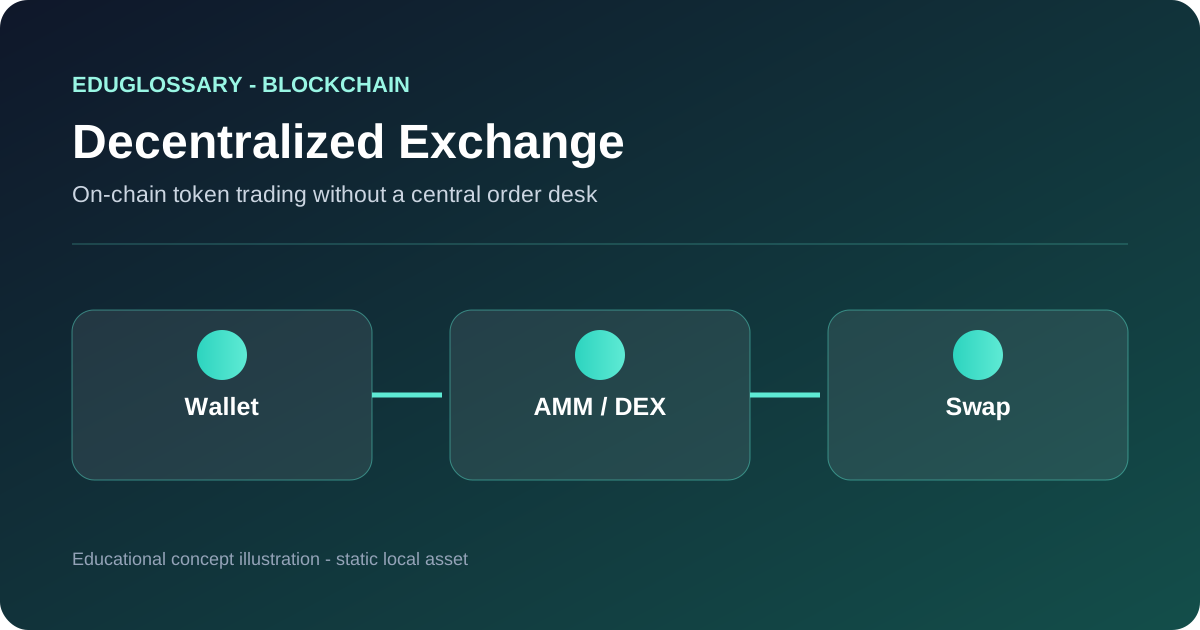
A Decentralized Exchange, or DEX, is a protocol that lets users trade digital assets through blockchain transactions and smart contracts. Instead of depositing funds into an exchange’s internal account and asking a central operator to match orders, a user generally connects a wallet, selects a trade, reviews the transaction, and authorizes a contract to execute the swap. The assets remain under the user’s key control until the transaction changes ownership.
DEXs are a major part of Decentralized Finance (DeFi), but they are not all built the same way. The design affects how prices are formed, how liquidity is supplied, how trades are ordered, and what risks participants take.
Automated Market Makers
Many DEXs use an automated market maker, or AMM. An AMM holds reserves of two or more tokens in a smart-contract pool and uses a mathematical rule to quote trades. A simple constant-product pool tries to keep the product of the two reserve balances within a specified relationship. A trade adds one asset and removes another, so the pool’s balance changes and the quoted price moves.
Liquidity providers deposit assets into a pool and receive a claim that represents their share. They may earn a portion of trading fees, but their result depends on trading activity, asset prices, pool rules, incentives, and the value of the assets when they withdraw. If the relative prices change, the provider can experience impermanent loss compared with simply holding the assets outside the pool.
Other DEXs use on-chain order books, concentrated-liquidity ranges, or hybrid designs. Order books resemble traditional markets but require a way to store, update, and match orders on a blockchain. Concentrated liquidity lets providers select price ranges, which can use capital more efficiently while requiring more active management.
How a Swap Works
The trader first chooses the input and output tokens, amount, and acceptable minimum output. The interface estimates the exchange rate, network fee, price impact, and sometimes a routing path through multiple pools. The user may need to approve a token contract before the swap contract can spend the input asset. A signed transaction is broadcast and processed by the blockchain.
The final output can differ from the estimate if the market moves, another transaction is included first, or the pool has limited liquidity. Slippage settings limit how far the result may move before the transaction reverts, but they cannot make a thin market liquid. Aggregators can route a trade across several DEXs to seek a better quoted result, adding more contracts and dependencies to the transaction.
DEXs Compared With Centralized Exchanges
A centralized exchange usually manages an internal ledger, holds customer assets, operates an order-matching system, and provides an account or withdrawal process. A DEX publishes its execution rules in contracts and uses the blockchain as the settlement layer. Centralized exchanges can offer fast matching, account recovery, and fiat services; DEXs can offer self-custody, transparent settlement, and access without the same account relationship.
Neither model removes all risk. A centralized exchange adds counterparty, custody, operational, and account-access risks. A DEX adds contract, wallet, oracle, transaction-ordering, liquidity, and token-authenticity risks. A token can also be designed so that selling is restricted or expensive even when a DEX displays it.
Transparency and Risks
Swaps, pool balances, and contract calls produce On-Chain Data, which can make activity auditable. Public visibility does not guarantee a correct interface, honest token code, or private identity. Addresses may be linked to people or services through external analysis.
Important risks include smart contract exploits, malicious tokens, oracle failures, bridge dependencies, front-running, sandwich attacks, congestion, and sudden liquidity changes. Users should check contract addresses through trusted documentation, understand approval permissions, review transaction details, and avoid treating a quoted price or past volume as a promise of future results.
Automated Market Makers and Order Books
DEXs can use different market structures. An automated market maker, or AMM, lets users trade against liquidity held in smart-contract pools. A pool follows a mathematical rule that determines how the relative quantities of its assets change as swaps occur. Liquidity providers deposit assets and may receive fees or other incentives according to the protocol’s rules.
Other DEX designs use on-chain or off-chain order books, intent-based execution, or aggregators that compare liquidity across several venues. The word DEX therefore describes a broad family of non-custodial trading mechanisms rather than one technical implementation.
Slippage, Price Impact, and Fees
The quoted price of a swap is not necessarily the final price received. Slippage describes the difference between the expected and executed outcome. Price impact describes how the trade itself changes the available price in a liquidity pool or market. A small trade in a deep pool may experience little price impact, while a large trade against limited liquidity can move the price significantly.
Transaction fees have several components. A user may pay the blockchain’s network fee, the DEX’s protocol fee, and potentially other routing or intermediary costs. On some networks, network fees can vary materially with congestion. A comparison of two swaps should therefore consider the complete execution cost rather than only the displayed token exchange rate.
Liquidity Providers and Impermanent Loss
Liquidity providers supply assets to a pool so that other users can trade against it. In exchange, they may receive a share of trading fees and, depending on the protocol, additional incentives. Providing liquidity exposes the provider to market risk and smart-contract risk.
In AMMs, the relative prices of pooled assets can change as traders rebalance the pool. Compared with simply holding the assets outside the pool, the provider can end up with a different asset mix and value. This effect is commonly called impermanent loss. Whether fees compensate for it depends on trading activity, price movements, incentives, and the exact pool design.
Routing and Aggregation
A DEX interface may route a trade through more than one pool or protocol. An aggregator can search available liquidity and split a swap across venues to seek a better execution outcome. This can improve routing efficiency, but it also expands the number of contracts and dependencies involved in a transaction.
Users should inspect the final transaction details, minimum received amount, token approvals, and destination contracts when their wallet provides those details. A familiar interface does not guarantee that every route or token is safe.
Evaluating a DEX
A technical evaluation can examine the contract addresses, audit history, upgrade controls, fee model, oracle dependencies, liquidity depth, supported networks, and known security incidents. Market data should be checked with more than one provider because reported volume and liquidity can use different filters and time windows.
A DEX also does not eliminate token-level risk. A swap can execute correctly while the purchased token is malicious, illiquid, incorrectly represented, or subject to restrictive transfer logic. Execution quality and asset quality are separate questions.
Token Approvals and Spending Permissions
Many token swaps require the wallet to grant a smart contract permission to spend a particular token. This approval is separate from the swap itself. Depending on the token standard and wallet interface, an approval can allow a contract to spend a limited amount or a larger allowance.
Users should distinguish a one-time approval from the actual trade and understand which contract receives the permission. Revoking unnecessary allowances can reduce exposure, but revocation is itself an on-chain transaction and therefore may incur a network fee.
Transaction Ordering and MEV
Public transaction systems can expose pending transactions before they are finalized. Other participants may sometimes observe this information and attempt to reorder transactions, trade around them, or capture a portion of the resulting value. These activities are often discussed under the broader term maximum extractable value, or MEV.
The practical impact depends on the blockchain, DEX design, transaction-routing system, and protection mechanisms. A DEX can reduce some forms of custody risk while leaving market-structure risks such as adverse ordering and liquidity shortages.
How to Read a DEX Quote
A useful quote comparison should include the input amount, expected output, minimum acceptable output, price impact, network fee, protocol fee, route, and deadline where those fields are available. The cheapest displayed rate is not necessarily the cheapest completed transaction when execution fees and price impact differ.
For educational analysis, distinguish the quoted price from the settled blockchain result. The latter is the transaction outcome after the network processes the swap.
Does a DEX require an account?
Usually it requires a compatible wallet rather than a traditional username and password. The wallet signs transactions, while the blockchain records the resulting state.
Are DEX trades free?
No. A trade may include a protocol fee, a liquidity-provider fee, a network transaction fee, and price impact. The exact costs depend on the network and market.
Does a DEX guarantee the best price?
No. Price quality depends on liquidity, routing, fees, transaction timing, and execution conditions. Aggregators can compare venues, but they also introduce additional dependencies.
Understanding execution quality
A quoted swap price is an estimate until the transaction executes. In an automated market maker, the requested trade changes the ratio of assets in a pool, so larger trades relative to pool depth cause greater price impact. Slippage tolerance sets how much the execution may differ from the quoted outcome before the transaction reverts; it is not a promise that the trade will fill at the displayed price. A user should compare the expected output, minimum output, network fee, protocol fee, and any route that crosses several pools.
A routing aggregator may split a swap across pools or venues to improve the result, but extra hops introduce more contracts, fees, and failure points. Price quotes also change as other transactions are submitted. Transaction ordering can expose a trade to sandwiching or other forms of MEV, especially when slippage tolerance is set too loosely. Private transaction routes may reduce some exposure, but they introduce their own trust and availability considerations.
Liquidity-provider risk
Liquidity providers earn fees under the pool’s rules but take exposure to price changes between deposited assets. Impermanent loss describes how a pool position can underperform simply holding the same assets when relative prices move; it can become a realized loss when the position is withdrawn. Fees may or may not offset that effect. Pool incentives, token emissions, and high displayed APRs should be evaluated separately from sustainable trading demand.
A safer trade checklist
Verify the chain, token contract address, token approval, recipient address, and the minimum output before signing. Review whether a token has transfer restrictions, upgrade permissions, or unusual taxes. Revoke unused spending approvals where practical, using trusted tools and after checking which network they operate on. Never assume that a DEX listing means a token has been audited or is legitimate.
DEXs reduce reliance on a central exchange operator for the swap itself, but they do not remove smart-contract, oracle, interface, wallet, bridge, liquidity, or regulatory risk. Evaluate the pool and the transaction rather than treating decentralization as a blanket safety guarantee.