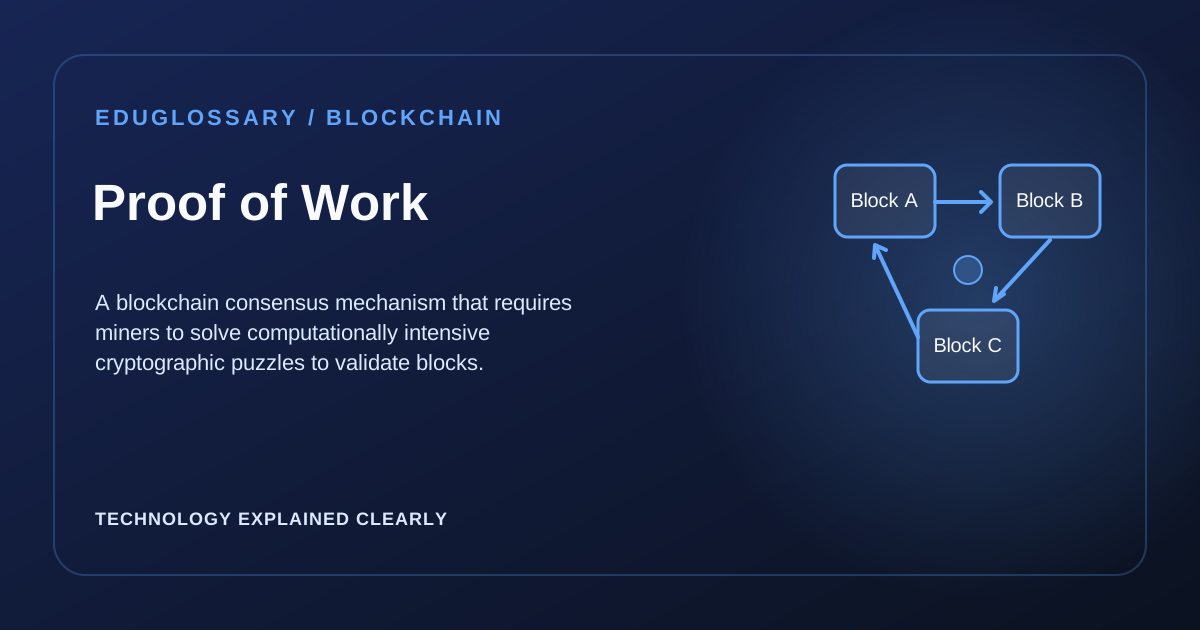
Proof of Work (PoW) is the first consensus mechanism used by Bitcoin and has been the gold standard of blockchain security for over a decade. In this system, miners compete to solve a mathematical puzzle that requires finding a specific nonce — a number that, when combined with block data and hashed, produces a value below the target set by the network.
The Mining Process Explained
Miners collect unconfirmed transactions into a candidate block, then try various nonce combinations through trial and error. Because SHA-256 hashing is one-way, the only way to find a valid nonce is through billions of trial attempts per second.
The process works like this:
- Transaction gathering: Miners collect pending transactions from the network
- Block construction: Transactions are organized into a block with a Merkle root
- Nonce searching: Miners repeatedly hash the block header with different nonces
- Solution discovery: The first miner to find a hash below the target wins
- Block propagation: The solution is announced to the network
- Verification: Other nodes verify the solution in milliseconds
- Chain extension: The new block is added to the blockchain
Security Through Cost
PoW security derives from the computational cost a malicious miner would need to expend to attack the network. To execute a 51% attack, an attacker would need to control over 50% of the network’s total hash rate. For Bitcoin, this would require:
- Billions of dollars in specialized ASIC hardware
- Millions of dollars in electricity costs
- Physical infrastructure to house and cool the equipment
- Ongoing operational expenses
This economic barrier makes attacking large PoW networks prohibitively expensive. An attacker would spend more on hardware and electricity than they could gain from a successful attack.
The Hash Rate Arms Race
Bitcoin’s difficulty adjustment ensures that blocks are found approximately every 10 minutes, regardless of total network hash rate. Every 2,016 blocks (~2 weeks), the network automatically adjusts difficulty:
- If blocks are found too quickly, difficulty increases
- If blocks are found too slowly, difficulty decreases
This creates a positive feedback loop: higher profitability attracts more miners, increasing hash rate, which increases difficulty, which reduces individual profitability. The equilibrium balances mining revenue against operational costs.
Energy Consumption Debate
Bitcoin’s estimated annual energy consumption is comparable to that of mid-sized countries like Austria or Norway. This raises important questions:
The security argument: The energy is not waste — it is the price of security. PoW converts computational work into an economic barrier that makes attacking the network prohibitively expensive.
The environmental concern: Most mining energy comes from fossil fuels, though the industry increasingly uses stranded renewable energy or flared natural gas.
Comparison to traditional finance: The energy cost of traditional banking systems (buildings, ATMs, armored cars, paper processing) is not zero either, though it is less visible.
Miner Economics
Successful miners earn rewards through:
- Block subsidy: Newly minted Bitcoin (currently 3.125 BTC per block after the 2024 halving)
- Transaction fees: Users pay fees to prioritize their transactions
- Stratum mining: Miners pool resources and share rewards proportionally
Mining profitability depends on:
- Electricity costs (typically 3-5¢/kWh is competitive)
- Hardware efficiency (J/TH performance)
- Bitcoin price
- Network difficulty
- Block subsidy rate
Hardware Evolution
Mining hardware has evolved dramatically:
- CPU mining (2009): Early Bitcoin could be mined on regular computers
- GPU mining (2010): Graphics cards offered better performance
- FPGA mining (2011): Field-programmable gate arrays provided efficiency
- ASIC mining (2013+): Application-specific integrated circuits dominate modern mining
Modern Bitcoin ASICs (like Antminer S19 series) can perform 100+ TH/s while consuming 3000+ watts.
Centralization Concerns
Despite its decentralization philosophy, PoW mining faces centralization pressures:
- Mining pools: Single entities controlling large portions of hash rate
- Geographic concentration: Mining clusters in regions with cheap electricity
- Hardware monopolies: Few manufacturers produce mining ASICs
- Economies of scale: Large operations have significant cost advantages
PoW vs Proof of Stake
| Aspect | Proof of Work | Proof of Stake |
|---|---|---|
| Energy use | Very high | Minimal |
| Security model | Computational cost | Economic stake |
| Hardware needs | ASICs required | Standard servers |
| Finality | Probabilistic | Can be deterministic |
| Entry barrier | High | Lower |
| Centralization risk | Mining pools | Large stakers |
| Example networks | Bitcoin, Litecoin | Ethereum, Cardano |
Alternative PoW Algorithms
Different blockchains use different hashing algorithms:
- SHA-256: Bitcoin’s algorithm, ASIC-resistant
- Scrypt: Litecoin’s algorithm, memory-hard
- Ethash: Ethereum’s former algorithm, ASIC-resistant
- RandomX: Monero’s algorithm, CPU-optimized
- KawPow: Ravencoin’s algorithm, GPU-friendly
Practical Applications Beyond Cryptocurrency
PoW concepts apply beyond blockchain:
- Spam prevention: Original purpose of PoW (Dwork & Naor, 1993)
- ** captcha systems**: Proving humanity through computation
- Distributed timestamping: Creating verifiable time records
- Rate limiting: APIs using PoW to throttle requests
The Future of Proof of Work
Bitcoin remains the most secure and valuable PoW network. While newer chains prefer PoS for efficiency, PoW’s battle-tested security model continues to attract users who prioritize decentralization and censorship resistance over speed and environmental concerns.
Hybrid approaches combining PoW and PoS elements are being explored, along with layer-2 solutions that don’t require changes to base-layer consensus.
Frequently Asked Questions
Why does Proof of Work require so much energy?
The energy consumption is not waste — it is the price of security. PoW converts computational work (electricity + specialized hardware) into an economic barrier that makes attacking the network prohibitively expensive.
What is a nonce?
A nonce (number used once) is a 32-bit field in the block header that miners vary to change the hash output. Changing any part of the input changes the hash unpredictably due to the avalanche effect.
What is “difficulty” and how does it adjust?
Difficulty sets the target threshold for valid hashes. Bitcoin adjusts difficulty every 2,016 blocks (~2 weeks) to maintain a 10-minute average block time.
Can Proof of Work be used for things other than blockchain?
Yes. The original concept was for spam prevention. Modern uses include captcha alternatives, rate limiting APIs, and distributed timestamping.
What happens when all Bitcoin is mined?
Bitcoin’s block reward halves every 210,000 blocks (~4 years). Eventually, miners will be compensated entirely by transaction fees. The security model remains the same.
Understanding mining economics and network incentives
Proof of work makes block production costly by requiring miners to search for a value that satisfies a difficulty target. The work is easy for other nodes to verify but expensive to discover. Difficulty adjustment helps a network keep block production near its intended pace as total hash power changes, although the exact adjustment rule differs between protocols. A nonce is one input miners vary, but modern mining also changes other block-header fields or transaction selections when searching for a valid block.
The security model is economic as well as computational. An attacker with substantial hash power may attempt to reorganize recent blocks or censor transactions, but the cost and practical effect depend on the chain’s total hash rate, hardware access, energy prices, mining-pool structure, confirmation depth, and attacker incentives. Hash rate is a useful indicator, not a complete guarantee; software bugs, custody failures, and social coordination can still cause losses.
Energy, hardware, and concentration
Mining consumes electricity and specialized hardware, so operators compare expected rewards with power cost, cooling, equipment depreciation, and the probability of earning a block. This creates incentives to seek efficient energy and scale, but low-cost locations and large facilities can concentrate production. Pools reduce the variance of miner income, yet a pool can become a coordination point with influence over transaction selection. The distinction between individual hardware owners and pool operators matters when assessing concentration.
Energy analysis should specify what is being measured and the time period. Estimates based on network-wide hardware and electricity assumptions carry uncertainty. Electricity consumption alone does not establish environmental impact; energy source, location, timing, and alternative uses of the power also matter. Avoid treating a single estimate as a permanent property of a network.
Practical confirmation policy
A payment recipient should decide how much reorganization risk is acceptable. Low-value transfers may require fewer confirmations than large, irreversible settlements. Exchanges and merchants should model the cost of a double-spend relative to the value and speed of the transaction. Miners should also consider pool policies and key security, not just advertised payout rates. Proof of work provides a specific way to order transactions under an economic threat model; it does not replace application-level security, safe wallet practices, or operational monitoring.
Example: interpreting a confirmation for a payment
A merchant accepting a proof-of-work cryptocurrency should define a confirmation policy based on the payment amount, the cost of a double-spend, transaction replacement rules, and network conditions. A zero-confirmation transaction is not equivalent to a transaction buried under additional blocks. A large payment may warrant more confirmations or a separate risk review, while a low-value payment may use a different policy. The policy should be explicit and consistently enforced.
Monitor network congestion, fee levels, block intervals, pool concentration, and relevant software changes. Sudden changes may affect settlement times or the confidence a recipient should place in a recent block. Wallet software may display a transaction as pending or confirmed according to its own rules, so high-value workflows should verify the intended chain and transaction status rather than trusting a screenshot from the sender.
Mining economics can shift when rewards, prices, electricity costs, or hardware efficiency change. These changes influence who can remain profitable and may change the distribution of hash power. They do not directly reveal every attack risk, but they are useful context alongside protocol rules, observed hash rate, and independent operational evidence.
Separate mining-pool influence from hardware ownership
Hash-rate concentration can be hard to interpret because individual miners may direct work through a pool, while the pool operator coordinates block construction. The operator’s influence is not identical to owning all underlying hardware, but it can still affect transaction selection and coordination. Review both pool distribution and the practical ability of miners to switch pools. Also consider whether a small number of equipment suppliers, energy sources, or hosting providers create common points of failure.
Changes to fees, reward schedules, and electricity prices can shift miner participation. A change in economic incentives may affect network security over time, but a single price movement is not enough to quantify attack cost. Reports should state the time window, data source, and assumptions used.
For application designers, the relevant outcome is how much settlement confidence a transaction needs and what evidence supports that decision. Use a risk-based confirmation policy and watch for abnormal reorganizations or network disruptions. Proof of work’s security properties depend on protocol rules and the distribution and cost of resources, not solely on the fact that miners perform computation.