Brotli is a compression format used to reduce the size of web responses and other data. On 21 October 2026, the Brotli project published version 1.2.1 to fix CVE-2026-111497, an out-of-bounds write in the native decoder that can permit remote code execution when an application decodes maliciously crafted input. The issue matters beyond a single application framework because runtimes and packages may bundle or call Brotli implementations independently.
The Node.js project included a fix in its 21 October security releases for the 22.x, 24.x, and 26.x lines. On 26 October, PHP announced rebuilt Windows packages that include Brotli 1.2.1. These notices illustrate an important operational lesson: updating a language runtime, a native library supplied by an operating system, and an application container are related but separate tasks.
Status checked: 29 October 2026. On 29 October, New Zealand’s National Cyber Security Centre said it was aware of active exploitation and public proof-of-concept exploits. Treat CVE-2026-111497 as an urgent, potentially actively exploited issue when an affected decoder is reachable; do not wait for proof that your own service has been targeted before checking exposure and patch status. Fix availability still differs by operating system, package repository, managed runtime, and region, so use the advisory for the exact product you operate.
What is CVE-2026-111497?
CVE-2026-111497 is a memory-safety vulnerability in Brotli decompression. According to the official Brotli release, malformed compressed input could cause the decoder to write beyond an internal buffer. The Node.js security notice explains that an invalid block switch was treated as though the decoder simply needed additional input, rather than as a permanent format error. In the affected path, a streaming decoder could continue appending bytes to an eight-byte internal buffer.
Writing outside the intended bounds of a buffer can damage adjacent process memory. Depending on the surrounding program, architecture, build options, and attacker control over input, memory corruption can crash a process, expose sensitive memory, or enable code execution. These are potential impacts described by vendor advisories, not proof that every application using Brotli is exploitable in the same way.
The vulnerable component is the decoder, not compression in the abstract. A service that only produces Brotli-compressed output may have a different exposure from a service that accepts and decompresses Brotli bytes from an untrusted source. The practical question is where bytes enter the system, which implementation decodes them, and what privileges that process has.
Why Brotli is used in modern software
Brotli is a lossless compression format commonly used to deliver HTML, CSS, JavaScript, SVG, and other text-based web resources in fewer bytes. A client can advertise supported encodings through Accept-Encoding; a server or CDN may then return a Brotli representation marked with Content-Encoding: br.
Compression can reduce bandwidth and transfer time, but encoding and decoding still consume CPU and memory. Static assets may be precompressed during a build, while HTTP clients and application frameworks can decompress responses automatically. This can hide a native decoder behind a high-level API.
The security boundary depends on data flow. A service that only compresses trusted files differs from one that decodes uploads, API bodies, archive data, or responses supplied by another system. Inventory the actual decoder and input path rather than assuming that only direct Brotli imports matter.
How the flaw can become a security incident
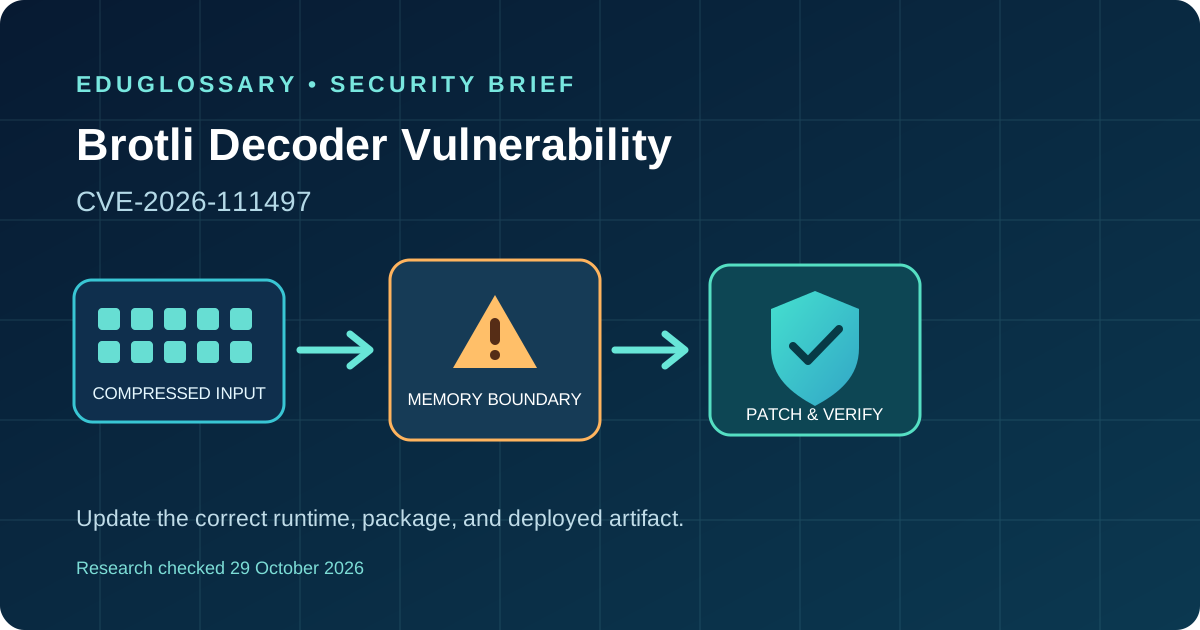
A client or upstream service supplies compressed bytes; an application, runtime, or library sends them to the Brotli decoder; and malformed input triggers an invalid memory write. Depending on the process, that can crash the service, disclose memory, or make code execution possible. Those are potential impacts, not proof that every application using Brotli is exploitable in the same way.
Reachability and exploitability are different questions. A product may contain a vulnerable library without exposing a path that accepts attacker-controlled Brotli input. Conversely, an unauthenticated endpoint that decodes arbitrary compressed data can have direct exposure. Authentication, network reachability, enabled features, proxy behavior, and process privileges all affect risk.
Do not send weaponized payloads to production to decide whether a service is vulnerable. Inventory versions, review vendor guidance, and conduct any deeper reproduction in an authorized isolated test environment.
What Node.js users should check
The Node.js security announcement dated 21 October 2026 lists CVE-2026-111497 among its high-severity issues. It affects the 22.x, 24.x, and 26.x release lines. The project’s fixed release baseline for that security round was Node.js 22.23.4, 24.22.1, and 26.12.1, respectively.
Node.js published later releases on 28 October: 24.22.2 and 26.13.0. Do not assume that a numerically newer runtime release automatically resolves this CVE. The Node.js 24.22.2 release notes list V8 and stream changes, not a new Brotli fix; AWS’s 28 October bulletin says the 24.22.1 security release has a known regression and that AWS is rolling out a targeted update to its current stable Node.js 24 runtime. For managed Node.js 24 services, verify the actual provider/runtime patch state instead of inferring it from process.version or the general release number. By contrast, Node.js 26.13.0 says it differs from 26.12.1 only in LTS metadata, so it retains the code changes from the fixed 26.12.1 security release.
A Node.js application can use the built-in node:zlib APIs to decompress Brotli data. Review code paths involving brotliDecompress, streaming decompression, HTTP libraries, and any service that accepts data from untrusted clients. A grep for one method name alone is not a complete dependency audit: wrappers and third-party packages can invoke the decoder on the application’s behalf.
For a managed hosting platform, distinguish the platform’s runtime from code and layers that the application deploys itself. A provider may patch its shared runtime, while a container image or function layer can continue to ship its own vulnerable copy. The AWS bulletin published on 28 October describes runtime-specific rollouts for CVE-2026-111497 and explicitly recommends customers rebuild and redeploy customer-managed container images after the updated base image is available. Read the status for the service and region you actually use.
What PHP users should check
PHP’s official news archive records two distinct October issues: the 21 October PHP 8.5.12, 8.4.27, 8.3.36, and 8.2.35 releases addressed CVE-2026-109618 and CVE-2026-109619, which are separate from the Brotli flaw. A runtime release for one CVE is not proof that a separately packaged decoder is fixed.
Second, on 26 October, the PHP team announced rebuilt Windows packages 8.5.12-1, 8.4.27-1, 8.3.36-1, and 8.2.35-1. The -1 suffix identifies a Windows package rebuild that includes Brotli 1.2.1; it does not mean that the PHP language runtime source version itself changed. PHP’s notice says the vulnerable decoder could be reached through the cURL extension when automatic HTTP response decompression is enabled. It notes that cURL disables that option by default, although applications and HTTP client libraries can enable it.
This distinction affects how an administrator verifies an installation. A Linux distribution may ship its own package with a backported patch, while a Windows binary distribution may publish a rebuild with a suffix. A container may use another package source entirely. Compare the installed package against the vendor’s bulletin; do not rely on the output of php -v alone if the vulnerable library is delivered separately from the visible runtime version.
PHP 8.2 is scheduled to reach end of life on 31 December 2026. Applying a security fix does not extend that support period; plan a supported-version upgrade separately.
The affected unit may be a dependency, not your application code
Brotli can be bundled inside a language runtime, installed as an operating-system library, compiled into a native extension, or pulled in through a transitive package. An HTTP client or framework may decode a response automatically, even if application source never calls a Brotli function directly.
Build an inventory across production servers, containers, worker processes, serverless functions, build images, and internal APIs. Use package-manager data, dependency scans, container SBOMs, runtime inventories, and vendor advisories together. A source search alone can miss bundled copies; a scanner can also miss a vendor backport or misread an older-looking package version.
If scanner results conflict with an operating-system advisory, retain the package evidence and reconcile the discrepancy rather than automatically suppressing the finding. Verify the component that is actually deployed, not only the dependency declaration in a repository.
A practical remediation checklist
1. Establish whether the decoder is present and reachable
Start with an inventory of production services and deployment artifacts. Include application servers, background workers, queues, command-line utilities, serverless functions, build images, and internal APIs. Determine whether each has a Brotli decoder and whether it processes input controlled by a remote user or upstream system.
Do not assume an application is unaffected just because no direct import appears in source code. Runtime and transitive-library dependencies need their own review. Conversely, do not claim compromise solely because a vulnerable package was installed: exposure and compromise are different questions.
2. Apply the correct vendor update
For Node.js, use the official security notice plus the runtime provider’s current advisory. The 21 October upstream fixes were included in Node.js 22.23.4 and 26.12.1; 26.13.0 retains the same code changes as 26.12.1. Node.js 24 requires extra care: its 24.22.1 security release lists the Brotli fix, but AWS reported a regression and described targeted managed-runtime rollouts; the 24.22.2 general release notes do not list a new Brotli fix. Do not infer CVE status from a higher patch number alone. For PHP on Windows, verify the relevant rebuilt package suffix from PHP’s official announcement. For Linux distributions, managed hosting, language-specific Brotli packages, and other runtimes, follow their own advisories and package versions. A patched upstream release does not prove that every downstream repository has already published or installed the fix.
3. Rebuild immutable artifacts
Updating a package on a developer’s laptop does not alter an image that has already been pushed to a registry. After updating dependencies or base images, rebuild the container or serverless artifact, publish it, deploy it, and verify the running digest or runtime version. If your platform owns runtime patching, check whether it is automatic, whether it requires an application update to pick up the patched runtime, and whether the update has reached the region you operate.
4. Reduce exposure while waiting for a patch
Where a vendor confirms that a specific decompression path is affected and a fix is not yet available, consider temporarily disabling Brotli decoding on that path or rejecting the relevant content encoding, if the architecture permits it safely. Apply such a workaround at the component that actually performs decompression. A reverse proxy setting does not protect an application that separately decompresses uploaded archives or API responses.
A workaround should be narrow, documented, tested, assigned an owner, and given a review date. Do not disable unrelated compression or weaken TLS settings based on this advisory. Do not treat input-size limits alone as a substitute for a memory-safety fix, although limits may reduce resource-exhaustion risks.
5. Verify and document the update
After deployment, confirm the effective runtime or package version from inside the actual running workload. Check the container digest, package manager output, process version, function layer, or vendor runtime status as appropriate. Run ordinary regression tests for compressed HTTP responses and client integrations, and monitor error rates, crashes, decompression failures, and unexpected restarts.
Keep a record of the affected asset, original version, chosen patch, deployment time, evidence of the running version, temporary controls, and any unresolved downstream package gaps. Close the vulnerability ticket only when the runtime and relevant dependency layers have been verified—not merely when a pull request has been merged.
Detection and incident response
If you see crashes around decompression, malformed-content errors, unusual memory consumption, or restarts in a process that handles untrusted compressed data, preserve relevant logs and deployment metadata. These symptoms are not unique to CVE-2026-111497 and do not prove exploitation. Investigate them alongside the affected component’s advisory and existing telemetry.
If evidence points to compromise, follow the incident-response process for the application. Isolate or constrain the affected workload where appropriate, preserve forensic evidence, rotate credentials that may have been accessible to the process, rebuild from trusted artifacts, and review outbound connections and privilege boundaries. A patch prevents future exploitation of that flaw; it does not automatically remove malicious code or undo access obtained earlier.
Frequently asked questions
Does this vulnerability affect every website that uses Brotli?
No. The vulnerability concerns a decoder path and the impact depends on the implementation and how it is exposed. A site that serves precompressed static files is not automatically in the same position as a service that decodes attacker-controlled compressed input. Inventory and vendor guidance are necessary to assess exposure.
Is updating Node.js enough for a container that has a Brotli package installed separately?
Not necessarily. Node.js distributes and maintains its own components, while a container can also include operating-system packages or application dependencies. Update and verify each applicable layer, then rebuild the final image.
Does the PHP -1 suffix mean a new PHP language version?
No. PHP’s 26 October notice describes a Windows package rebuild with an updated Brotli dependency. The PHP runtime source version remains the same; the suffix identifies the rebuilt package.
What should I do if my distribution has not published a fix?
Follow the distribution’s advisory and check whether a backported update or supported patched image is available. If the decoder is reachable and no fix exists, apply a narrow vendor-recommended mitigation such as disabling that decompression path where practical, and continue monitoring for a patch. Record the residual risk and reassess it regularly.
Sources and further reading
- Node.js Project, 21 October 2026 security releases.
- Node.js Project, Node.js 24.22.2 release, 28 October 2026.
- Node.js Project, Node.js 26.13.0 release, 28 October 2026.
- PHP Project, 2026 news archive: Brotli rebuild and PHP security release, updated 26 October 2026.
- Google Brotli, v1.2.1 release, 21 October 2026.
- New Zealand National Cyber Security Centre, CVE-2026-111497 affecting Brotli decoder, 29 October 2026; notes active exploitation and gives a product-by-product patch status.
- Amazon Web Services, CVE-2026-111497 security bulletin, 28 October 2026; includes managed-runtime rollout details and explains the Node.js 24 update caveat.