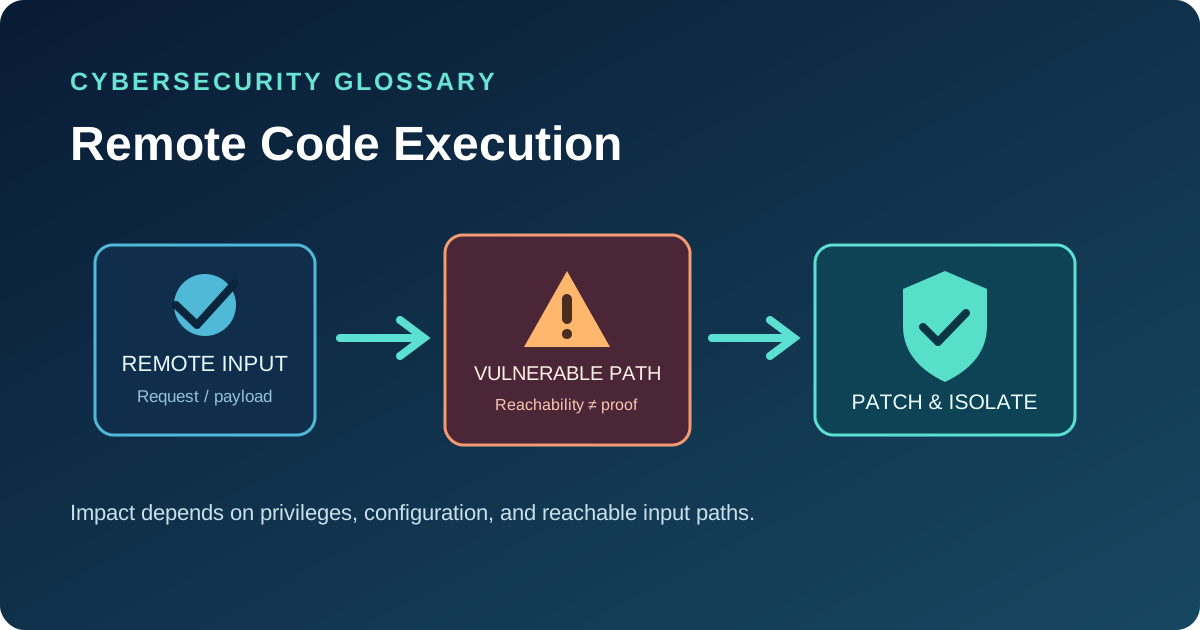
Remote code execution (RCE) is a security impact in which an attacker can cause code or commands to run on a system from another device or through a remote interface. The term describes what an attacker may be able to make the target do; it does not, by itself, explain the vulnerability, the attacker’s permissions, or how likely exploitation is.
RCE is serious because software often runs with access to application data, service credentials, network connections, or operating-system resources. The consequences depend on the process privileges and isolation controls. An RCE in a tightly restricted worker is not equivalent to arbitrary command execution as an administrator, but it can still expose sensitive data or provide a foothold for further activity.
How remote code execution happens
A remote application accepts requests or data across a network. If a vulnerability causes that input to be interpreted as executable instructions—or lets an attacker corrupt memory and redirect execution—the application may run attacker-controlled code. Common root causes include unsafe deserialization, command injection, template injection, memory-corruption bugs, insecure plugin systems, and flaws in native parsers or language runtimes.
A typical attack path has several stages:
- Reachability: the attacker can contact an endpoint or influence data processed by the target.
- Trigger: specially crafted input reaches a vulnerable code path.
- Execution primitive: the defect permits control over a command, code object, program counter, or other execution decision.
- Process-level impact: the code runs with the privileges of the affected service or subprocess.
- Follow-on actions: depending on permissions and network access, the attacker may try to read data, access secrets, persist, or move to another system.
Not every vulnerability completes every stage. A reported flaw may require authentication, a particular configuration, user interaction, or an unusual sequence of operations. Security triage should capture those prerequisites rather than treating every item containing the term RCE as equally exploitable in every deployment.
RCE compared with related terms
Code injection is a class of weakness in which input is interpreted as code or commands. It can create RCE, but the phrase does not automatically mean the vulnerability is remotely reachable. A local process might be vulnerable to code injection from a local file or user input.
Command injection occurs when data unexpectedly changes a command executed by a shell or operating-system utility. For example, unsafe concatenation of user input into a shell command can allow an attacker to add operations. Safe argument passing and avoiding a shell where possible reduce this risk.
Remote code execution is an impact classification rather than a single root cause. A buffer overflow can permit RCE without any script or shell command being concatenated. Likewise, an unsafe deserialization flaw can instantiate objects or invoke behavior that leads to code execution.
Remote command execution is sometimes used interchangeably with RCE, but may emphasize running operating-system commands rather than instructions inside a language runtime. In vulnerability reports the exact meaning depends on the implementation and proof of impact.
Privilege escalation increases the permissions available to an attacker who already has some foothold. RCE and privilege escalation can occur together, but they are not identical. A service may permit code execution as an unprivileged user, followed by a separate privilege-escalation weakness.
Why an RCE does not always mean a system was compromised
A vulnerability describes a condition that could be exploited; a compromise is an event in which an attacker actually took an unauthorized action. An affected version is evidence of exposure, not conclusive evidence of a successful attack. Conversely, a patched system can still be compromised if exploitation occurred before remediation.
A realistic assessment considers the vulnerability’s technical preconditions, internet or internal network reachability, authentication requirements, configuration, exploit availability, security controls, and the importance of the affected process. Public exploit code or reports of active exploitation can increase urgency, but absence of public proof is not proof that a system cannot be attacked.
The correct response to an RCE advisory is to establish exposure, apply vendor fixes promptly, and investigate suspicious activity where risk warrants it. Do not make a blanket claim that all systems running a named product have been breached.
How a vulnerable parser can lead to RCE
Native parsers process structured input such as images, archives, compressed streams, fonts, media, certificates, and network protocols. A memory-safety flaw can cause a parser to write outside a valid buffer, use freed memory, or miscalculate the amount of data that fits in a destination. Under some conditions, this corruption can alter control data or program state and lead to code execution.
CVE-2026-111497 is a recent example. The Brotli project’s 21 October 2026 release of version 1.2.1 identifies an out-of-bounds write in decompression that permits remote code execution. The Node.js security notice says malformed compressed input could cause the decoder to write beyond an internal buffer. That issue illustrates why the data format alone does not define risk: the critical factors include which decoder is used and whether an attacker can influence the bytes it processes.
The same library may be included in several products with different update mechanisms. A runtime can bundle a copy, an operating system can package a shared library, and an application can include a third-party binding. Fixing one copy does not prove that all other copies have been updated. Software inventory and deployment verification are therefore part of remediation.
Common RCE exposure patterns
Internet-facing applications
Public web applications, API endpoints, file converters, image processors, archive extractors, and protocol gateways may receive input from anonymous users. If a vulnerable parser or interpreter handles that input, the network boundary offers a potential route to the weakness. Restricting upload formats, validating input, limiting resource use, and patching parsers all help—but validation must be appropriate to the format and cannot replace a vendor security fix for memory corruption.
Internal services and trusted networks
An endpoint is not automatically safe because it is private or reachable only from an internal network. Compromised employee devices, partner integrations, other services, or a cloud workload can be sources of untrusted input. Internal trust should be paired with authentication, authorization, segmentation, and monitoring.
Build systems and package managers
Build workers often hold tokens or credentials that are more powerful than the application runtime needs. An RCE in a build tool, package installer, test runner, or parser may therefore expose release secrets or alter artifacts before deployment. Use isolated, ephemeral jobs; restrict token permissions; protect trusted workflows; and separate production secrets from untrusted pull-request code.
Containers and managed runtimes
A container is a packaging and isolation mechanism, not a guarantee that vulnerable code is harmless. A process may still read mounted secrets or reach internal services permitted by its network policy. Managed platforms can patch shared runtime components, while customer-supplied containers or layers may retain older libraries. Verify the final deployed artifact and the provider’s runtime update procedure.
How to reduce RCE risk
Patch the affected component
Use the official project or vendor advisory to identify fixed versions and update the component that contains the vulnerability. In ecosystems with backported patches, package version strings may not match upstream numbering, so confirm the distribution’s own security status. Rebuild and redeploy immutable artifacts rather than assuming a source change updates an existing image.
Minimize privileges
Run services as dedicated non-administrator users. Limit filesystem permissions, writable directories, mounted credentials, outbound network access, and access to the container runtime or host. Least privilege does not remove the vulnerability, but it can reduce the damage that successful code execution permits.
Make input handling safer
Avoid constructing shell commands from untrusted strings. Use parameterized APIs, safe deserialization formats and schemas, strict parser APIs, and explicit allowlists where appropriate. Enforce upload size, nesting depth, decompressed size, execution time, and concurrency limits. These controls address different failure modes; none is a substitute for updating vulnerable memory-unsafe components.
Use defense in depth
Authentication, authorization, web application firewalls, sandboxing, seccomp profiles, process isolation, container restrictions, egress filtering, and runtime monitoring can make exploitation harder or limit impact. They should be selected based on the architecture and tested as independent controls. A WAF signature may miss a new input variant, and an egress rule may limit exfiltration without preventing code execution itself.
Keep software inventory and security evidence
Track direct and transitive dependencies, operating-system packages, runtime versions, container digests, and the services that consume them. A Software Bill of Materials can help describe components, but it must be generated or maintained for the deployed artifact and reviewed alongside vendor advisories. Record who owns the update, what was changed, and what evidence confirms that the fix is running.
What to do when exploitation is suspected
Treat credible signs of successful execution as an incident, not merely a patching task. Follow the organization’s incident-response plan, isolate affected assets where this will not create greater harm, preserve logs and disk or memory evidence where appropriate, and establish a timeline. Look for unusual child processes, new files, unexpected outbound connections, changes to application code, abnormal authentication, and unexpected secret access.
If a process could read credentials, rotate relevant secrets from a clean environment after containment. Rebuild from known-good artifacts and restore trust in the pipeline that created them. Simply restarting the vulnerable application or installing a patch does not prove that persistence has been removed. Where notification or regulatory obligations may apply, involve the responsible security, legal, and privacy teams.
Frequently asked questions
Is an RCE always unauthenticated?
No. Some RCE vulnerabilities require authentication, a specific role, a configuration option, or a sequence of user actions. Unauthenticated RCEs can be especially urgent because the target may need to accept input before an identity is established, but all reported prerequisites should be reviewed.
Does using a firewall eliminate RCE risk?
No. A firewall can reduce network reachability, but exposed endpoints, internal attackers, compromised peers, or other input channels may still reach the vulnerable function. Patching and layered controls remain necessary.
Is a crash proof of RCE?
No. A crash may indicate a parser or memory-safety bug, but it does not show that an attacker gained code execution. Preserve evidence and evaluate the behavior with the vendor’s advisory and an authorized, controlled reproduction.
What is the first priority after an RCE advisory?
Identify whether the affected component is present and exposed, determine the vendor’s fixed version for your platform, and plan the update. If there are credible signs of exploitation, initiate incident response in parallel rather than waiting for routine patch deployment to finish.
Sources and further reading
- Node.js Project, October 2026 security releases.
- Google Brotli, v1.2.1 security release.
- PHP Project, 2026 news and security advisories.
- CISA, Secure by Design for architectural practices that reduce exploitable weaknesses.