On 20 October 2026, Mozilla published an incident update explaining that private keys associated with eight eMudhra intermediate certificates had been compromised. The keys could be used to issue fraudulent certificates for websites or code-signing identities outside the certificate holder’s control. The incident matters because browser security depends on more than encryption: a client must also establish that the server on the other end is the right server.
This does not mean every website using an eMudhra-issued certificate was hacked. A compromised certificate authority (CA) key creates the possibility of impersonation, but an attack also depends on certificate issuance, connection interception or redirection, and whether the client trusts the affected chain. The event requires a coordinated response from browser vendors, certificate operators, website owners, and software publishers.
Status checked: 22 October 2026. Certificate trust decisions and migration guidance may change as affected trust-store operators and certificate subscribers complete their response. Check the official status updates linked below before changing production certificate configuration.
What happened?
Mozilla’s public incident tracker says it received a report on 17 October 2026 at 20:06 UTC that the private keys for eight eMudhra intermediate certificates had been compromised. Mozilla acknowledged the report, confirmed proof that the keys were exposed, and began removing trust in the affected certificates. The tracker also records that Mozilla was able to recover the keys independently, indicating that the issue was not simply a report of a lost device or an isolated operational leak: the key-generation process itself was flawed.
Of the eight affected intermediates described in the tracker, six were TLS certificate authorities and two were code-signing certificate authorities. The TLS intermediates were trusted by major browser and operating-system root programs, according to the incident record. The code-signing intermediates were trusted by Microsoft’s program. The scope therefore included both the identity presented by HTTPS websites and the signatures used to establish software publisher identity.
What is a certificate authority and an intermediate certificate?
A certificate authority is an organization or system trusted to issue digital certificates. A web server presents a TLS certificate containing a public key and identifiers for the service, such as a domain name. The client checks the certificate’s signature chain, validity period, permitted use, revocation status where checked, and whether the name in the certificate matches the server it intended to reach.
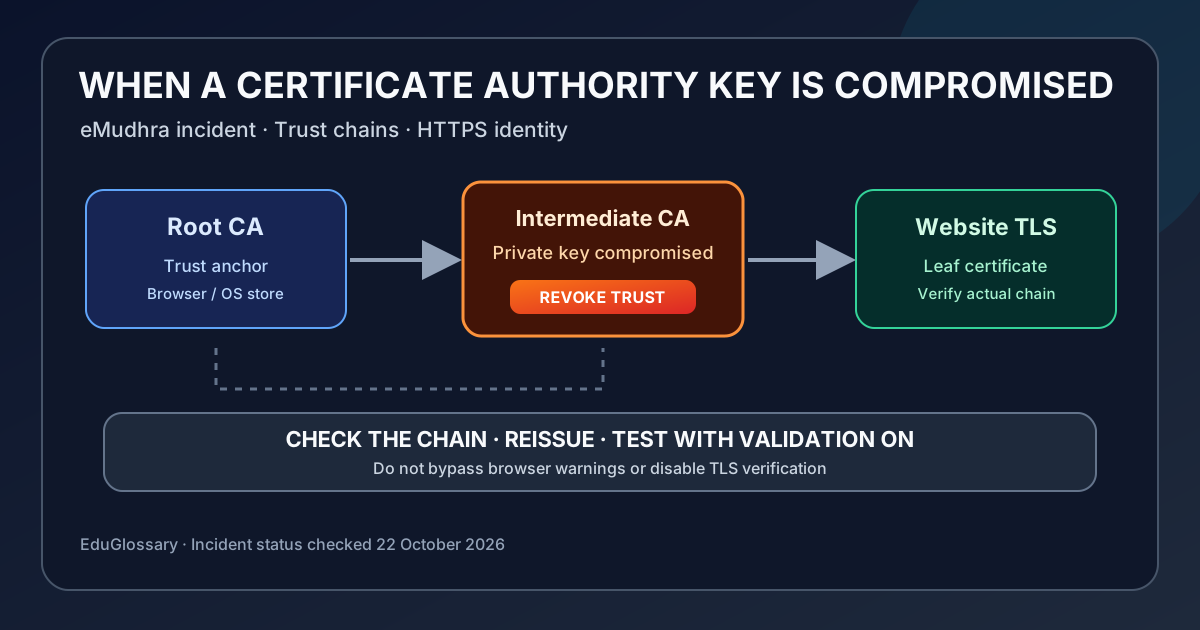
Trust normally forms a chain:
- Root CA: a trust anchor included in a browser, operating system, runtime, or application trust store.
- Intermediate CA: a certificate authority signed by a trusted root or another intermediate. It can issue certificates to end entities within its constraints.
- Website or code-signing certificate: the leaf certificate that identifies a particular server or publisher.
The intermediate allows a root’s signing key to remain offline or tightly protected during routine issuance. It also gives the CA ecosystem flexibility to divide issuance by product, policy, or operational environment. But an intermediate is itself a powerful signing credential. Its key must be generated with strong cryptographic randomness, protected from unauthorized access, monitored, and revoked when its security can no longer be trusted.
Why could compromised CA keys undermine HTTPS?
HTTPS relies on two related but separate properties:
- Confidentiality and integrity: TLS encrypts data in transit and protects it against modification by an attacker who cannot defeat the protocol.
- Authentication: certificate validation helps the client decide whether the server is authorized to represent the requested website.
If an attacker can use a trusted intermediate private key to issue a valid-looking certificate for a domain they do not control, encryption by itself does not solve the problem. The connection may be encrypted to an impostor. If the attacker can also intercept or redirect the victim’s connection, the fraudulent certificate could enable impersonation and potentially exposure or modification of traffic.
That does not make all connections vulnerable automatically. A successful real-world attack requires a usable fraudulent certificate and a position or mechanism that allows the attacker to influence the victim’s connection. But the trust store must respond before relying on that chain becomes unsafe. This is why browser and platform vendors distribute certificate distrust updates, sometimes outside the normal major-version release cycle.
A CA compromise is also different from a certificate expiration event. An expired certificate is no longer valid because its time window has ended. In a compromise, a certificate may still be within its validity period, but its issuer can no longer be trusted to protect identity. A certificate that appears unexpired can therefore still become untrustworthy.
What has Mozilla and the browser ecosystem done?
Mozilla’s incident update, published on 20 October, describes several layers of response:
- Firefox blocked the affected intermediate certificates through OneCRL, Mozilla’s centralized list of revoked or distrusted certificates. The incident tracker says the update reached standard Firefox configurations by 22:59 UTC on 17 October, under three hours after the report.
- Firefox 158.0.1 for desktop and Android, plus Firefox ESR 115.43.1 and ESR 153.5.1, included a baked-in copy of the updated blocklist for users whose custom settings might prevent OneCRL updates.
- Mozilla updated the NSS certificate library trust list to remove the root certificate that signed the affected intermediates, helping applications that use that trust store but do not obtain OneCRL updates.
- A subsequent entry in Mozilla’s public incident tracker says Mozilla decided to remove trust in emSign ECC Root CA - G3 as an emergency measure for clients that do not reliably process intermediate revocation. It asked eMudhra to stop issuing from intermediates that chain to that root and migrate subscribers to alternative chains.
The same tracker records that eMudhra agreed to stop issuance from intermediates chaining to the G3 ECC root. It gave an initial estimate of about 30,000 certificates requiring migration, with approximately 97% having been issued through ACME. It identified intermediates chaining to the G1 RSA root as the available alternative at that time. The tracker also records that Chrome committed to a similar approach.
These are dated incident developments, not a guarantee that every browser, operating system, programming runtime, or third-party trust store has the same state right now. Different products update trust through different mechanisms and schedules. A website administrator should follow their CA’s specific migration instructions and test the chain from the clients that matter to their users.
Why the Node.js October security release mentions certificate data
Node.js’s 21 October 2026 security releases include root-certificate updates in addition to fixes for DNS, TLS hostname validation, the Brotli decoder, cryptographic randomness, and other issues. The Node.js 22.23.4 and 24.22.1 release notes list an update of the root certificates to NSS 3.131.1, while the 26.x release notes also include a corresponding certificate-store update.
This is a good example of why application security is broader than updating the application’s own source code. A JavaScript service can depend on the runtime’s TLS implementation and trust data when calling APIs or authenticating upstream services. Updating Node.js does not reissue a certificate installed on a website or CDN; reissuing that certificate does not update an old runtime or browser trust store. Identify which component of the chain affects the deployment.
What website operators should do
1. Determine whether your certificate chain is affected
Do not assume that every certificate issued by a company is affected or that an apparently valid leaf certificate is safe. Review the issuer and chain of each public certificate against the current incident notice and the certificate authority’s subscriber instructions. Record the subject, issuer, serial number, fingerprint, expiry, and deployment location where useful.
Inventory certificates across production, staging, alternate domains, load balancers, CDN endpoints, API gateways, origin servers, and internal services. A certificate that exists in a cloud console but is no longer attached to traffic should be distinguished from a currently serving certificate. Likewise, one domain may terminate TLS at several different layers.
2. Follow the CA’s official migration and reissuance guidance
If the CA identifies your certificate as affected, follow its supported process to reissue or replace it through a chain trusted by your target clients. In this incident, Mozilla’s public tracker recorded an alternative path via G1 RSA-chain intermediates for migration away from the G3 ECC root, but administrators should verify current instructions from their specific CA and certificate product before acting.
ACME users should check their certificate automation account, issuer configuration, deployment hook, and renewal logs. Do not assume automatic renewal has already migrated to a different chain. Automation may continue to request certificates through an old issuer or deploy a newly issued certificate only to one of several endpoints.
3. Verify the full live chain, not just the certificate file
After replacement, inspect the certificate actually presented to clients. Confirm the leaf certificate’s subject alternative names, dates, issuer, and chain; verify that the deployment is serving the intended intermediate chain and that a fresh TLS connection succeeds without bypassing validation.
A local certificate file or a successful control-panel status is not enough. CDNs, reverse proxies, web servers, load balancers, and application containers can each hold a different certificate. Test from an external client and, where possible, from a client environment representative of your users. Watch for incomplete chains and clients that still use stale trust data.
4. Keep certificate validation enabled
Never respond to certificate errors by disabling TLS verification, setting a global “accept any certificate” option, or telling users to ignore browser warnings. That removes the control designed to prevent impersonation. If a legitimate certificate chain fails after the trust update, correct the certificate, chain, or supported client configuration instead of weakening validation.
For a Node.js client, avoid setting rejectUnauthorized: false as a workaround. For command-line diagnostics, do not treat a request made with certificate checks disabled as proof that HTTPS is functioning securely.
5. Check all places that consume trusted certificates
Review server runtimes, outbound API clients, containers, Java or Python services, reverse proxies, command-line tools, and software build systems. Each can use a different trust store or update schedule. On managed workstations and mobile devices, follow the browser and operating-system vendor’s supported update process; do not install a random certificate bundle from an unverified source.
Organizations that sign software should also monitor the code-signing side of the incident. Browser TLS distrust and software-signing trust are different mechanisms, so a browser update alone should not be assumed to solve every code-signing trust question.
6. Preserve logs and investigate suspicious activity proportionately
The report of compromised CA keys is evidence of a trust-infrastructure incident, not proof that a particular website was attacked. If your service used an affected chain during the exposure window, assess its exposure and review relevant TLS termination, certificate issuance, DNS, CDN, and access logs. Look for unapproved certificate replacements, unexpected issuance activity, unusual routing changes, and signs of intercepted or misdirected connections.
Preserve relevant evidence before rotating or rebuilding systems. If you discover suspicious activity, follow your incident-response plan and consult your security team or provider. Avoid claiming that a customer data breach occurred without evidence linking the incident to that outcome.
How to inspect a live TLS connection
For an initial diagnostic on a system with OpenSSL installed, replace example.com with your actual domain:
openssl s_client -connect example.com:443 -servername example.com -showcerts -verify_return_error </dev/nullThis shows the certificates presented during the TLS handshake and asks OpenSSL to report verification errors. Its result depends on the local OpenSSL build and trust store, however, so it cannot prove that all browsers or operating systems trust the same chain. Use the certificate authority’s instructions and more than one representative client when diagnosing a production incident.
For a regular HTTPS request, you can also run:
curl -Iv https://example.com/Do not add options that disable certificate verification to make the command succeed. If the test fails, capture the exact error and determine whether it concerns trust, name matching, expiration, or an incomplete chain. Do not publish private key material, certificate-management credentials, or sensitive infrastructure details in logs or support tickets.
What this incident teaches developers
The incident highlights four durable security practices:
- Protect key generation: weak randomness can undermine otherwise strong cryptographic algorithms.
- Maintain revocation paths: clients need a reliable way to stop trusting compromised certificates before they expire.
- Update trust stores: browsers, operating systems, and runtimes need current roots and revocation data.
- Verify identity, not just encryption: clients must validate the certificate chain and the expected DNS name or IP address.
Automation can accelerate ACME renewal, but it needs current issuer settings, deployment verification, and monitoring. No single measure can compensate for an issuer chain that should no longer be trusted.
Frequently asked questions
Does this mean HTTPS is broken everywhere?
No. The incident affects specific keys and trust chains. Most HTTPS connections that do not rely on affected chains are not automatically compromised.
Should every website immediately replace its certificate?
Identify your chain and follow authoritative guidance. Replace affected certificates, but avoid mass replacement without checking the issuer, supported chain, and client compatibility.
Is updating Node.js enough?
No. A runtime update does not change a separate web-server or CDN certificate. Depending on the deployment, both a runtime update and certificate migration may be needed.
Can I ignore a browser certificate warning if the website looks legitimate?
No. A familiar page does not authenticate a server. Never bypass the warning; verify the chain or contact the operator through a separate trusted channel.
Official sources and further reading
- Mozilla Security Blog: Protecting Firefox users following the compromise of eMudhra intermediate certificates, 20 October 2026 — Mozilla’s public explanation of its Firefox response.
- Mozilla Bugzilla: eMudhra private key compromise of intermediate certificates — incident timeline and subsequent trust-store decisions, including the G3 root response.
- Chromium source change: adding compromised eMudhra intermediates to the blocklist — a Chrome implementation change dated 20 October 2026.
- Node.js 24.22.1 LTS release notes — security fixes and certificate trust-store update.
- Node.js 26.12.1 release notes — corresponding Current-line security updates.
- RFC 9525: Service Identity in TLS — the IETF standard for verifying server identities in TLS.
The operational takeaway is clear: identify the exact certificate chain, follow the current CA and browser guidance, replace affected credentials through a trusted path, and verify real client connections with validation enabled. The incident is a reminder that trustworthy HTTPS requires sound key generation, reliable revocation, and continuous maintenance of the systems that decide whom to trust.