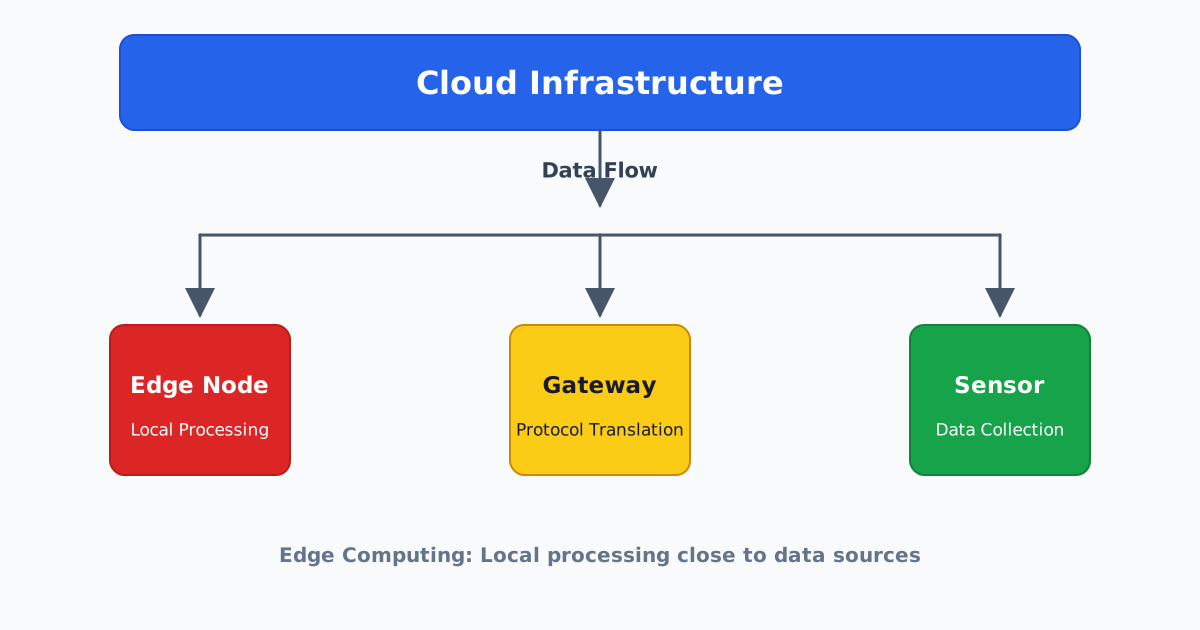
Edge computing is a distributed computing paradigm that brings computation and data storage closer to the location where it is needed to improve response time and save bandwidth. This architectural shift addresses the limitations of traditional cloud computing by decentralizing data processing workflows, reducing reliance on centralized data centers, and enabling real-time decision-making for latency-sensitive applications.
What Is Edge Computing?
Edge computing refers to the practice of processing data near the edge of the network, where the data is being generated, rather than transmitting it to a distant centralized cloud or data center. The “edge” can be a factory floor, a retail store, a cell tower, an autonomous vehicle, or any location where sensors and devices produce data.
The core idea is simple: if data can be analyzed and acted upon where it originates, organizations can reduce latency, minimize bandwidth costs, and improve privacy by keeping sensitive information local. Edge computing does not replace cloud computing; instead, it complements it by handling time-critical processing locally while deferring less urgent analysis and long-term storage to the cloud.
How Edge Computing Works
Edge computing operates through a layered architecture that distributes workloads across edge devices, edge gateways, regional infrastructure, and centralized cloud services.
Layer 1: Edge Devices
Edge devices are the physical hardware at the periphery of the network. These include sensors, IoT devices, smart cameras, industrial controllers, and embedded systems. Each device collects data from its environment—temperature readings, video feeds, machine vibration patterns, GPS coordinates, or user interactions—and performs preliminary processing.
Modern edge devices often contain microcontrollers or system-on-chip (SoC) processors capable of running lightweight operating systems and executing basic analytics. For example, a smart camera in a retail store can count customers and detect movement patterns locally without streaming video to the cloud.
Layer 2: Edge Gateways and Local Compute Nodes
Edge gateways act as intermediaries between edge devices and broader network infrastructure. A gateway aggregates data from multiple devices, performs protocol translation (converting sensor-specific formats to standard IP-based protocols), and executes more complex processing tasks than individual devices can handle.
Local compute nodes—sometimes called edge servers or micro-data centers—provide additional processing power at the edge. These are small, ruggedized computing units deployed in factory closets, cell towers, or retail back offices. They can run containerized applications, machine learning inference models, and real-time analytics engines.
Layer 3: Regional Infrastructure
Regional infrastructure includes aggregation points, regional data centers, and carrier hotels that sit between the edge and the central cloud. These facilities handle workloads that require more compute than an edge gateway can provide but do not need the full scale of a hyperscale cloud region. They also serve as caching layers for content delivery networks (CDNs) and as connection points for network operators.
Layer 4: Cloud Services
The cloud layer provides centralized management, long-term storage, and heavy-duty analytics. Data that has been filtered, aggregated, or anonymized at the edge is transmitted to the cloud for model training, historical analysis, billing, and cross-site insights. Cloud platforms such as Amazon Web Services (AWS), Microsoft Azure, and Google Cloud offer edge-specific services that extend their reach closer to end users.
Data Flow in Edge Computing
Data in an edge computing system follows a tiered path:
- Ingestion: Sensors and devices collect raw data continuously.
- Local Processing: Edge devices and gateways filter noise, detect anomalies, and trigger immediate actions (such as shutting down overheating equipment).
- Selective Transmission: Only relevant or summarized data is sent upstream, reducing bandwidth consumption.
- Cloud Analysis: Aggregated data is stored and analyzed in the cloud for trend identification, model retraining, and enterprise reporting.
This distributed flow ensures that time-critical decisions happen locally while strategic insights emerge from centralized analysis.
Use Cases
Industrial IoT and Predictive Maintenance
In manufacturing, edge computing enables real-time monitoring of production lines. Sensors on machinery collect vibration, temperature, and pressure data every second. Edge gateways analyze this data locally to detect early signs of equipment failure. If a motor begins to overheat, the edge system can trigger an automatic shutdown before damage occurs, preventing costly downtime.
This approach requires low latency—often in the millisecond range—which centralized cloud computing cannot consistently guarantee due to network round-trip times.
Autonomous Vehicles
Self-driving cars generate terabytes of data per day from cameras, LiDAR, radar, and ultrasonic sensors. Processing all this data in the cloud would introduce dangerous delays. Edge computing within the vehicle itself handles obstacle detection, lane keeping, and emergency braking in real time. Only non-critical data—such as trip summaries and map updates—is transmitted to the cloud when connectivity is available.
Smart Cities and Traffic Management
Urban infrastructure uses edge computing to manage traffic signals, monitor air quality, and respond to emergencies. Edge nodes at intersections analyze camera feeds to adjust signal timing dynamically based on current traffic conditions. This reduces congestion and improves response times for emergency vehicles without depending on a distant data center.
Healthcare and Remote Monitoring
Wearable medical devices and hospital sensors use edge computing to monitor patient vitals continuously. Edge processing can detect cardiac arrhythmias or falls immediately and alert medical staff. Raw physiological data is stored locally for privacy compliance, while anonymized trends are sent to cloud platforms for population health research.
Content Delivery and Streaming
Content delivery networks (CDNs) are an early form of edge computing. By caching video, images, and web content at edge locations close to users, CDNs reduce load times and improve streaming quality. Modern CDNs also execute edge functions—small pieces of code that run at the edge to personalize content, authenticate users, or modify responses without contacting the origin server.
Edge Computing vs. Cloud Computing
| Feature | Edge Computing | Traditional Cloud Computing |
|---|---|---|
| Processing Location | Near the data source | Centralized data centers |
| Latency | Low (milliseconds) | Higher (tens to hundreds of milliseconds) |
| Bandwidth Usage | Minimal; only essential data transmitted | Significant; raw data often sent upstream |
| Data Storage | Distributed, often temporary | Centralized, long-term |
| Scalability | Limited by local hardware | Virtually unlimited |
| Connectivity | Can operate with intermittent internet | Requires reliable internet |
| Security Model | Decentralized; more attack surfaces | Centralized control and monitoring |
Edge computing is not a replacement for cloud computing. Most production deployments use a hybrid model where edge nodes handle real-time processing and the cloud handles storage, training, and cross-site analytics.
Edge Computing vs. Fog Computing
Fog computing is a related but distinct concept. While edge computing emphasizes processing directly on devices or gateways at the network edge, fog computing introduces intermediate “fog nodes” between the edge and the cloud. Fog nodes are typically located in local area networks or at carrier facilities and provide additional processing, storage, and networking services.
In practice, the terms are sometimes used interchangeably, but fog computing generally refers to a broader architecture with multiple tiers of distributed compute, whereas edge computing focuses on the devices and gateways closest to data sources.
Edge Computing vs. Content Delivery Networks
Content delivery networks cache static content (images, videos, JavaScript files) at edge locations to improve delivery speed. Edge computing goes beyond caching by executing code at the edge. A CDN might serve a cached video file; an edge computing platform might transcode that video in real time, insert personalized advertisements, or run content moderation algorithms before delivery.
Benefits of Edge Computing
Reduced Latency
By processing data locally, edge computing eliminates the round-trip delay to centralized data centers. This is critical for applications such as industrial control, autonomous driving, and augmented reality, where decisions must be made in milliseconds.
Bandwidth Efficiency
Transmitting raw sensor data to the cloud can consume significant bandwidth, especially for video and high-frequency telemetry. Edge systems filter and aggregate data locally, sending only meaningful events or summaries upstream. This reduces network costs and congestion.
Improved Reliability
Distributed edge architecture reduces single points of failure. If a cloud region experiences an outage, edge nodes can continue operating independently and process critical workloads locally. When connectivity is restored, data can be synchronized with the cloud.
Enhanced Privacy and Compliance
Edge computing allows sensitive data to remain on-premises or within a specific geographic region. This supports compliance with data residency regulations such as the European Union’s General Data Protection Regulation (GDPR) and industry-specific requirements in healthcare and finance.
Cost Optimization
Processing data at the edge reduces the volume of data transmitted to and stored in the cloud, lowering data egress and storage costs. Organizations can use cloud resources selectively for high-value analytics rather than paying to store and process every byte of raw telemetry.
Challenges and Limitations
Operational Complexity
Managing hundreds or thousands of distributed edge nodes is substantially more complex than administering a centralized data center. Organizations need tools for remote provisioning, configuration management, software updates, and health monitoring across diverse hardware and locations.
Security Risks
Edge devices are often physically accessible and deployed in uncontrolled environments, making them vulnerable to tampering, theft, and unauthorized access. Each edge node represents a potential attack vector. Security measures must include device authentication, encrypted communications, secure boot, and regular patching—all of which are harder to enforce at scale in distributed environments.
Interoperability
Edge ecosystems involve devices and protocols from multiple vendors. Ensuring compatibility between sensors, gateways, and cloud platforms requires adherence to standards such as MQTT, OPC UA, and CoAP. Lack of standardization can lock organizations into proprietary solutions.
Maintenance and Hardware Lifecycle
Edge hardware in remote locations—such as cell towers, offshore platforms, or rural installations—requires physical maintenance. Replacing a failed edge gateway may involve truck rolls and on-site technicians, increasing operational costs compared to replacing a server in a data center.
Limited Compute Resources
Edge devices have constrained processing power, memory, and storage compared to cloud servers. Complex machine learning models or large-scale data analytics must be optimized for edge deployment or offloaded to the cloud.
Security Considerations
Security in edge computing requires a defense-in-depth approach:
- Device Identity: Each edge node should have a unique, verifiable identity using certificates or hardware security modules.
- Encrypted Communications: Data in transit between edge devices, gateways, and the cloud must be encrypted using TLS or equivalent protocols.
- Secure Boot and Updates: Edge devices should verify the integrity of firmware and software before booting, and updates should be signed and delivered through secure channels.
- Network Segmentation: Edge networks should be isolated from corporate IT networks to limit the blast radius of a compromise.
- Physical Security: Devices in public or semi-public locations need tamper-evident enclosures and, where possible, tamper-detection mechanisms.
Real-World Examples
Major cloud providers have invested heavily in edge computing platforms. AWS offers AWS Wavelength, which places compute and storage at the edge of 5G networks, and AWS Snowball Edge, a ruggedized device for edge computing in disconnected environments. Microsoft Azure provides Azure Stack Edge, an AI-enabled appliance for edge AI and IoT scenarios. Google Cloud offers Distributed Cloud Edge, which extends Google Cloud infrastructure to customer premises and edge locations.
These platforms demonstrate that edge computing is no longer experimental—it is a production-ready architecture adopted by enterprises across manufacturing, telecommunications, retail, and transportation.
Conclusion
Edge computing represents a fundamental shift in how data is processed and acted upon. By decentralizing computation and bringing it closer to data sources, organizations can achieve lower latency, reduced bandwidth costs, improved reliability, and stronger data privacy. Edge computing complements rather than replaces cloud computing, creating a continuum from the edge to the cloud where workloads are placed where they deliver the most value.
As 5G networks expand, IoT deployments grow, and AI inference moves closer to end users, edge computing will become an increasingly essential component of modern IT infrastructure. Organizations that understand its architecture, benefits, and trade-offs will be better positioned to design systems that are responsive, resilient, and cost-effective.
References
- IEEE. “Edge Computing: Architecture, Applications, and Challenges.” IEEE Xplore Digital Library. https://ieeexplore.ieee.org/document/9456321
- Amazon Web Services. “AWS Wavelength Documentation.” AWS Documentation. https://docs.aws.amazon.com/wavelength/
- Microsoft Learn. “What Is Azure IoT Operations?” Azure documentation. https://learn.microsoft.com/en-us/azure/iot-operations/overview-iot-operations
- Amazon Web Services. “AWS Lambda Documentation.” https://docs.aws.amazon.com/lambda/latest/dg/welcome.html